
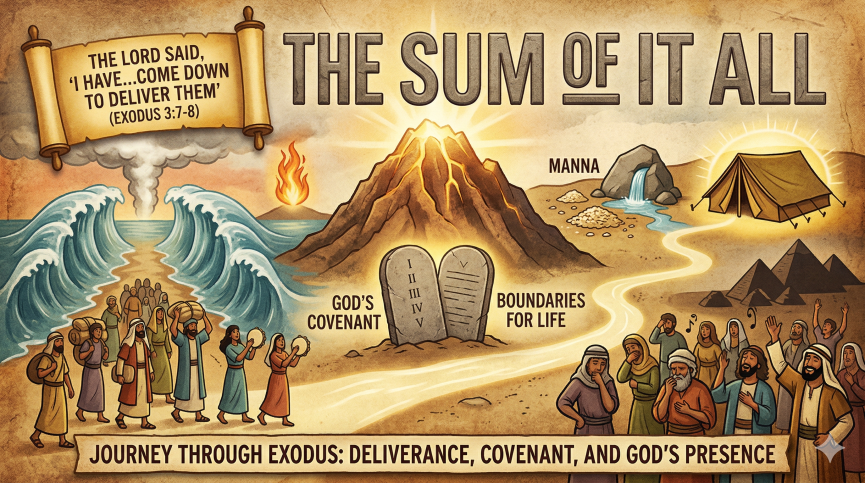
The Sum of It All
“Then the LORD said, ‘I have observed the misery of my people who are in Egypt; I have heard their cry on account of their taskmasters. Indeed, I know their sufferings, and I have come down to deliver them’ ” (Exodus 3:7-8).
Week 5, Day 1
EXODUS 13–15
Since the Israelite firstborn were spared from the death angel, the people were to consecrate all their firstborn, both human and animal, to the Lord. This would be a reminder that the Lord had brought them “out of Egypt, from the house of slavery” (13:14). They were to be a covenant people, led by a safe route since they were not ready for war (13:17) and guided by the quiet, continuing miracle of cloud and fire.
But (like you and me) they were an obstinate lot. They rebelled as they faced the sea, contending that it would have been better to stay in Egypt than to die in the wilderness. How could they so quickly forget the power of the Lord from the Passover night? Most of us, if we reflect honestly upon our own journey, will understand. We so soon forget the pain of the slavery from which we have been saved and the glory and mercy of God in our deliverance.
But as they saw their pursuers destroyed, they joined Moses in singing a song of deliverance. Then Miriam, Moses’ sister, picked up the theme. Tambourine in hand, she led the women in dancing and singing: “Sing to the LORD, for he has triumphed gloriously” (15:21). They were only three days down the road, however, when they not only forgot the songs they had sung with Moses and Miriam but complained bitterly against Moses at their shortage of water. God used the occasion to add a new dimension to their covenant (15:25b-26).
PRAYER: Give me a sanctified memory, I pray, so that when I am inclined to grumble against you, I will remember your mercy. Amen.
Record the pendulum swing of the actions of God, the troubles endured, and the negative and positive responses of the people.
Week 5, Day 2
EXODUS 16–18
God provided food (16:35), water (17:6), and victory in battle (17:13). The people provided the grumbling. Each day seemed to require a new miracle if the people were to carry on, and always they seemed ready to return to Egypt where they “ate [their] fill” (16:3) and had plenty to drink (17:3). When I was seventeen a man named Herman Pencovic told me, “The Jews remembered the leeks and garlic of Egypt after they had forgotten the taskmasters and the making of bricks without straw.” Most of us have just such a selective memory when we recall the good old days.
The visit by Jethro, Moses’ father-in-law, is a special kind of bright spot in the midst of Israel’s struggles. Wise as Moses may have been, he was using his time and energy poorly; leaders are often inclined that way because they see themselves as indispensable. Jethro gave Moses advice that was ingenious and good sense: Share the burden. From a religious point of view, Jethro might have been seen as a pagan; he was not one of the people of Israel.
If Moses had been more narrow in his sympathies, he would have refused this counsel; after all, God had been speaking to him directly, so why should he listen to an outsider? But Moses was both wise enough and humble enough to learn even from an in-law! Here’s a lesson in common grace: God speaks to all his creation, to the degree we are willing to listen.
PRAYER: Dear Lord, help me to be ready to learn, no matter what channel or instrument you use to teach me; in our Savior’s name. Amen.
Make a list of the varieties of ways, in these chapters, that God met Israel’s needs.
Week 5, Day 3
EXODUS 19–20; PSALMS 31–32
Out in the wilderness there is a mountain called Sinai. It is not the tallest mountain in the world, but it may well be the best known. Israel had been on the road long enough to know they needed the structure of law. Even the best and most careful drivers need a line to show which is their side of the road, and a sign to indicate who will stop at an intersection. Life together requires boundaries.
Although this law was to deal with the most practical issues, it was not ordinary; it was the gift of God. Moses made this clear by establishing restrictions of many kinds so the people would understand that Sinai was holy ground.
The Ten Commandments come from a basis of God’s right and our debt. So they begin, “I am the LORD your God, who brought you out of the land of Egypt, out of the house of slavery” (20:2). God has a right to our loyalty because of the deliverance we have received. The degree to which we are at peace with God’s commands is probably directly related to our sense of his salvation.
The first four commandments regard our direct responsibility to God; the last five our duties to our fellow human beings; the fifth, the command to honor our parents, is a kind of bridge between them. But the responsibility to God comes first; as a philosopher has said, if there is no God, then anything goes.
PRAYER: Help me, I pray, to know with the psalmist that your word is a lamp to my feet and a light to my path; in Christ our Lord. Amen.
In what order would you place each of the Ten Commandments if you were listing them by importance? Justify your order.
Week 5, Day 4
EXODUS 21–23
I am struck by the simplicity and directness of these laws, and by their mercy, too. If at times they seem severe, the severity is on the side of the injured. It seems almost taken for granted that there will be respect for truth; without it, witnesses are meaningless and the whole structure of the law collapses. Undergirding everything in these laws is a sense that life is lived under the hand of God. All justice and judgment is in the end dependent on this conviction and on the quality of life that comes from it.
There is a restraint on power. In a world where slavery was practiced, these laws limited the slave owner; if he broke a slave’s tooth, the slave was set free in compensation for the tooth (21:27). At a time when women were subservient, protections were nevertheless provided (22:16-17). Perhaps the most helpless in society were the aliens, but they were to be treated fairly because “you were aliens in the land of Egypt” (22:21). And as for the poor, lend to them and do not take interest; and if the surety for your loan is your neighbor’s cloak, don’t keep it at night, for “in what else shall that person sleep?” (22:25-27).
And above all, there shall be justice. You shall not side with a majority (23:2), nor take a bribe (23:8), nor shall you even in pity be partial to the poor (23:3). Your fairness shall extend to the land, allowing it to rest every seventh year (23:10-11).
PRAYER: Give me regard, O Lord, for your commandments, so that I am fair to my fellow human beings and to all creation; in your name. Amen.
Find four or five examples of biblical laws dealing with common things that have their basis in a sense of justice or of divine purpose.
Week 5, Day 5
EXODUS 24–26
These chapters may bore a modern reader. Who cares, we ask, about the details of the ark of the covenant or the materials that went into the tabernacle with its table and lampstand and framework and curtains? Do these things matter to us today?
Actually, yes. Centuries later the writer of the New Testament Letter to the Hebrews will talk about these matters because he sees in them a foreshadowing of the new way of life in Jesus Christ. “This is a symbol of the present time” (Hebrews 9:9). The Greek word that in this verse is translated “symbol” is usually translated “parable.” Perhaps it will help if we will look upon these detailed descriptions as a physical parable of the glory and completeness that can be found in Christ.
So the Christian reader has an advantage over the ancient counterpart. The original reader knew the material was important because of the repeated command that it should be made “according to the pattern . . . which is being shown you on the mountain” (25:40; 25:9; 26:30). It is important for us because we have encountered the reality for which the original was only a shadow.
The intricate details of these chapters will also remind us that it is an awesome thing to appear before the Lord of the universe. Let it be done rightly and reverently, as befits such an engagement.
PRAYER: Lord of my life, give me a proper sense of your power and majesty, lest I become casual in your presence; to your glory. Amen.
What articles in a contemporary house of worship might seem comparable to the ark, the table, the lampstand, and the curtains?
Week 5, Day 6
EXODUS 27–30
To read these chapters faithfully and effectively, we have to move a distance into the world of the Jewish people. The altar represented so many things that ancient rabbis made each letter of the Hebrew name for altar the initial of a word, so the four letters would speak of forgiveness, merit, blessing, and life. The horn was a symbol of power and salvation; to take hold of the horns of the altar meant to lay claim on the power of God.
So, too, with the garments of the priests. The twelve stones on the breastplate, bearing the names of the twelve tribes of Israel, signified that the priest was always bearing the people before God in prayer; it is a quality that a parish pastor, at his or her best, would emulate. The priestly anointing was equally specific. Blood, the symbol of life, was touched to the ear of the priest, that it might be consecrated to hear God’s word; to the hand, so he might perform properly the duties of the priesthood; and to the foot, so that he would walk in righteousness (29:20). When he was sprinkled with blood, it reminded the people that atonement can be found for our sins, and when with oil, that there is light and joy in godliness (29:21).
And all of this, in the end, was that they should “know that I am the LORD their God, who brought them out of the land of Egypt that I might dwell among them; I am the LORD their God” (29:46).
PRAYER: May my worship always end, O God, in the recognition that you are the Lord of my life; to your honor. Amen.
In these chapters, blood is often an important factor in worship. List three hymns that include references to the blood of Christ, to the covenant, or to Communion.
Week 5, Day 7
EXODUS 31–33
The Hebrew Scriptures look upon skilled craftsmanship as true wisdom; thus Bezalel and Oholiab are called by God and “filled . . . with divine spirit” (31:1-6). But talent is only as good as the use to which we put it. Even the best gifts of God can be made cheap and destructive. So it is that Aaron used his sacred office to collect gold from the people from which to make a golden calf. When Moses confronted him, Aaron first blamed the people (“They said to me, ‘Make us gods’ ” [32:23]) without acknowledging his own abdication of leadership, then blamed circumstances (“I threw it into the fire, and out came this calf” [32:24]).
Moses, too, had a talent. It is too complex to be easily defined, but it is available at least in a measure to every child of God. Moses chose to stand between the people and God, pleading their cause to God, and pleading God’s cause to the people. His commitment was so intense that he challenged God to blot his own name from the divine record if the people were to be rejected (32:32).
Moses’ prayer is effective: “The LORD said to Moses, ‘I will do the very thing that you have asked’ ” (33:17). Yet even so, Moses was not granted the favor of seeing God’s face. The ultimate reward of those who exercise Moses’ gift is that they will see God’s will accomplished in the world and will see a body of people (or a single individual) restored to communion with God.
PRAYER: Lord, help me know such concern for the welfare of others that I will plead their cause faithfully before you; in Christ. Amen.
What persons or what offices in modern Christendom might seem comparable to Bezalel and Oholiab?
Prayer Time
Let us list five specific places of worship for which we will offer prayer daily—for the people who worship there, for those who provide leadership, for the weary or the casual who may come.
Kalas, E. J. (2016). The Grand Sweep: 365 Days From Genesis Through Revelation. Abingdon Press.
How the Drama Develops EXODUS 13–33
In the drama of life as we experience it, no week is so crucial as the one that follows a climactic occasion—especially a climactic victory. Life’s great events are almost always followed by the routine, and it’s in the routine that we are so easily caught off guard. Israel had been in Egypt for 430 years, most of the time as slaves. Now they are free, headed to the land of promise.
But it isn’t going to be easy. The journey to fulfillment never is. First, there is the Red Sea, which is enough to make the people feel they never should have left Egypt. Then a common complaint, the daily menu! In the eternal measure of things, this may seem trivial; but then you remember what happened to Esau when he was hungry, and you remind yourself that life is lived out at just such common junctures. Still worse, for Israel, there is a shortage of water. In each instance of trouble, the people blame God and lodge their complaints with God’s representative, Moses.
Life’s problems rarely, if ever, have simple solutions. Mostly, they have to be lived with, contained and controlled so they do not frustrate the ultimate purposes of our living. One such aid comes in quite human fashion in Exodus 18 when Jethro, Moses’ father-in-law, gives him some administrative counsel intended to save Moses both time and frustration. Then, at quite another level, in Exodus 20, Moses receives the Ten Commandments, a profound and eternal pattern of conduct.
Does it seem trivial to link Jethro’s advice and the Decalogue, as if the two were somehow comparable? I do so only to indicate that our lives are lived by both great principles and by simple hints and insights. And while no managerial advice is to be compared with the Ten Commandments, both have a place in our lives.
Life is also minutiae. The Ten Commandments seem to cover all the really great issues, but the Israelites will have to fulfill those commandments in everyday places—the world of nature, of daily labor, and of other people, including possible enemies. So details must be spelled out. Their house of worship also has details that seem like minutiae. In the instance of the portable Tabernacle, however, the details are crucially significant, because they have meaning beyond taste and aesthetics. The Hebrew Scriptures considered each detail to be holy, each one revealing something of the character of God and of their relationship to God. Later, the New Testament writers would find symbolic importance in each part.
Call it grace, call it the work of the Holy Spirit, call it a miracle; I only know that the best history of the church is written in little names.
—From Strong Was Her Faith: Women
of the New Testament (2007, 2012);
page 59
But as our plot continues to unfold, it is with a people who are on the move. I will dare to say they are on a pilgrimage, though they don’t often act that way. More often they seem to be no better than a group of grumbling tourists who think they ought to be getting better provisions for what they’ve invested. That may seem a strange statement for a people who have been delivered from slavery, but they dare now and then to suggest that they were better off when they were slaves. No matter; they are headed for a destination that, while it is not clearly known, is full of promise, a place of “milk and honey.” That prospect keeps them going, even if sometimes falteringly. And if the specific destination is not entirely clear, the way there is even more complicated. That’s the way life is—full of promise but rarely simple.
Seeing Life Through Scripture
Next to the Twenty-third Psalm, the Ten Commandments are probably the most familiar longer passage of Scripture. People may not know where to find them or be able to recite all ten; but they know they exist, they probably can tell you two or three, and they’re sure that they’re important.
If taken as presented, they are not simply important; they are crucially so. Obviously, it matters whether we believe in “You shall not murder,” “You shall not commit adultery,” “You shall not steal.” But the general human community is likely to miss the most important commandments, the ones that undergird all the other more easily recognized ones. These commandments begin with “You shall have no other gods before me,” and all else ultimately depends on the seriousness with which one accepts this commandment.
If the commandments are at face value important, what can be said for the details of the ancient Tabernacle? Is there anything to be learned, other than perhaps some little-understood cultural history? I believe so. At the least, let us be reminded that places can be sacred, not in the sense that they are to be worshiped but in the sense of bringing reverence to our lives. And let us confess we tend to be short of that sense of the sacred, of the reverent, today. We should let some hush settle on our lives when we read of a people who once built, and moved with them, a place of worship, a site of sacredness, in the howling wilderness.
Kalas, E. J. (2016). The Grand Sweep: 365 Days From Genesis Through Revelation. Abingdon Press.