
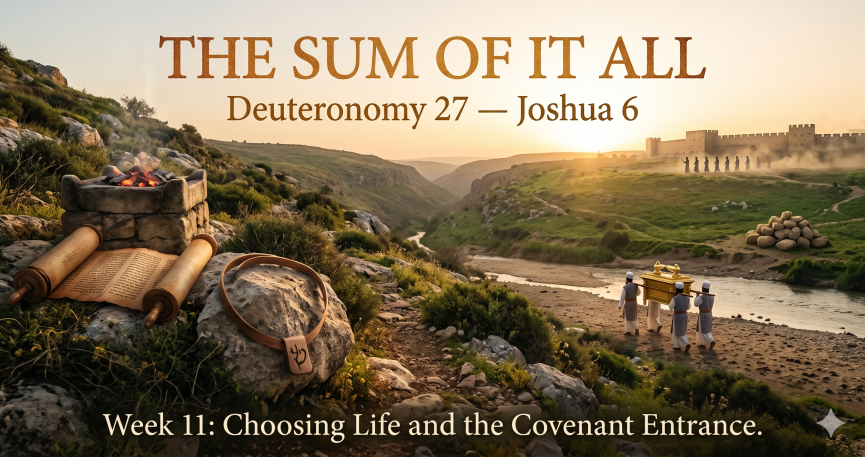
The Sum of It All
“You shall put these words of mine in your heart and soul, and you shall bind them as a sign on your hand, and fix them as an emblem on your forehead. Teach them to your children, talking about them when you are at home and when you are away, when you lie down and when you rise. Write them on the doorposts of your house and on your gates” (Deuteronomy 11:18-20).
DEUTERONOMY 27–29
Week 11, Day 1
When we’re about to enter unexplored land, whether a new school, a new job, or a marriage, we need a ritual of entrance. Some are simple and unstructured; but usually the more significant the event, the more solemn the ritual. As Israel prepared to enter their new homeland, they stood on the slopes of Gerizim and Ebal while the Levites stood in the valley between, pronouncing first a blessing toward Gerizim and then a doom toward Ebal. A Jewish commentator calls it the most imposing, solemn, and impressive event conceived for such an occasion. With each blessing and curse, the people were to say Amen to indicate their agreement with the contract. Only the curses are listed here; rabbis say that the blessings were negations of the dooms.
The same theme is carried forward in Chapter 28, but this time by a listing of blessings and curses without a list of the commands. The message of doom is longer than the promise of blessings. Perhaps this is because we human beings seem to be moved more by threats than by promises of favor. At the least, the Israelites had to confess that they were properly and vigorously warned!
But in spite of the sometimes threatening language, the call is to the good life. If the Israelites miss, it will be “because you did not serve the LORD your God joyfully and with gladness of heart” (28:47). In Egypt they had been slaves; here they were to be co-workers with God.
PRAYER: Father, make me wise enough to know that blessings and curses are built into life, and that the choice is mine; in Christ.
The curses listed here are probably just a sampling. Under what several headings would you group the ones that are given?
DEUTERONOMY 30–32
Week 11, Day 2
If the mixture of life’s blessings and troubles seems fearful, it is because we have forgotten God’s rule in the whole process. If we will learn from the fortunes and misfortunes and will “return to the LORD . . . , then the LORD your God will restore your fortunes” (30:2-3). Mercy is woven into all the fabric of life, even into those sections that seem at the moment to be ugly.
The lawgiver becomes an evangelist as he nears the end of his speech. “See, I have set before you today life and prosperity, death and adversity. . . . Choose life . . . , loving the LORD your God, obeying him, and holding fast to him” (30:15, 19, 20). There could hardly be a more impassioned call to the altar of decision.
But now it is time for the changing of the guard. No matter how often Israel rebelled against Moses’ leadership, they must now have felt very uneasy at the prospect of continuing without him. But they have a grand assurance: “The LORD your God himself will cross over before you. . . . Joshua also will cross over before you” (31:3). They can enjoy the same confidence they knew before, because again God is with them, working through a visible leader. Moses seems for a moment to strike a bitter note (“I know well how rebellious and stubborn you are” [31:27]), but he seems nevertheless to be confident they will learn: “Take to heart all the words that I am giving . . . you today” (32:46). Well, we shall see!
PRAYER: Help me, O Lord, to choose well today, and every day. Amen.
Moses said that the commandment he was giving was not difficult or out of reach. How would you summarize this challenge, as found in Deuteronomy 30:11-20?
DEUTERONOMY 33–34; PSALMS 52–53
Week 11, Day 3
Like the patriarchs before him, Moses pronounced blessings as he died. In his case, however, he was blessing not simply his own descendants but an entire nation, tribe by tribe.
What a beautiful way to die! But if we are to die with a blessing on our lips, we’ll have to get in practice early. Ordinarily we are, in our old age and in our dying, what we have been in earlier years, only written larger.
One could say that Moses spent the first two thirds of his life preparing to lead Israel—first through formal education in the courts of Egypt and then in a character seminar on the back side of the desert—and the last third of his life providing that leadership. The days of leadership were anything but tranquil, and at times Moses was impatient with the people. But he never ceased to love them and to plead for them. Now, ready to die, he reminds them what a fortunate people they are:
“Happy are you, O Israel! Who is like you,
a people saved by the LORD” (33:29).
Moses was not a perfect man. At times he fell into self-pity, and he wasn’t above blaming Israel for his problems. He became impatient to a point that he lost his opportunity to enter the land of promise. Yet there was no one like him. He saw the Lord and did God’s will (34:10).
PRAYER: I’m not expecting to be a Moses, dear Lord, but I want to be true to you in my place, in my time; in Jesus’ name. Amen.
Why would Moses bless the tribes individually instead of simply blessing the nation as a whole?
JOSHUA 1–3
Week 11, Day 4
Moses is dead; and now Joshua, Moses’ assistant, will carry on. He is assured that God will be with him as with Moses, and he must therefore be “strong and very courageous” and “act in accordance with all the law. . . . Meditate on it day and night” (1:7-8).
Sometimes the Lord surprises us by the people he employs. One would hardly expect a prostitute to be the key human figure in the invasion of Jericho—and one certainly wouldn’t expect her to become part of the lineage of the Messiah (Matthew 1:5) nor heralded as an example of both faith (Hebrews 11:31) and works (James 2:25). But perhaps that’s because we become so absorbed with outward appearances while God looks at the heart. Rahab, plying a rough trade in a pagan city, nevertheless had such a capacity for God that she would put her life on the line for what she was coming to believe.
Forty years earlier, ten of the twelve spies melted in fear before the inhabitants of the land, but now the two-man scouting party reports that “the LORD has given all the land into our hands” (2:24). But first the people must sanctify themselves (3:5) to be ready for the conquest; and before they can see God’s power at the Jordan River, they must step forward in faith (3:15-16).
PRAYER: Give me the grace, I pray, to see the potential you have invested in every human being, including those I might scorn. Amen.
What connection do you see between the miracle of crossing the Jordan River and the crossing, a generation earlier, at the Red Sea?
JOSHUA 4–6
Week 11, Day 5
We need devices to help our spiritual memory even more surely than we do to assist the everyday secular process. New generations will forget the faithfulness of God to their ancestors unless there is something to help them. So the Israelites built a mound of twelve stones (4:1-9) to recall God’s faithfulness—just as we celebrate the sacrament of Holy Communion to recall our Lord’s sacrifice (Luke 22:19).
But the memory of the past is not enough; each new generation must have its own commitments. As the saying puts it, God has no grandchildren. So this new generation must be circumcised as evidence that they too are God’s covenant people (5:2-7).
And now, the victory at Jericho. Symbolism is present in the priests leading the way, blowing the rams’ horns before the Lord, with the ark of the covenant following. It is there also in the use of numbers: seven priests because seven is the number of completeness or perfection; then, six days of marching but with the victory on the seventh day, the customary day of rest, as if to say that this triumph is God’s doing, not theirs. And at last a shout, an act of faith.
Some will explain the Jericho story with the data of physics; some will see it as a miracle needing no explanation; still others will interpret it symbolically. But for Israel, it was evidence God was with them.
PRAYER: I have my Jerichos now and then, dear Lord; break their walls before me, I pray; in Jesus’ name. Amen.
What, do you think, is the meaning of Joshua’s encounter with the angelic commander of the Lord’s army?
JOSHUA 7–9; PSALM 54
Week 11, Day 6
When life goes bad, a first inclination is to give in to despair, perhaps even to the point of thinking all is lost. That’s what Joshua did after the defeat at Ai. But it was no time for wailing. God said, “Stand up! . . . Israel has sinned” (7:10-11). It was a time to think and then to get at the root of their problems.
The remedy was a fierce one. Achan was destroyed, with his family, who were seen as party to his theft. And then on to an even fiercer chapter as Israel wiped out the city of Ai: “For Joshua did not draw back his hand . . . until he had utterly destroyed all the inhabitants of Ai” (8:26).
I will not ask that we agree with all that happens in this often bloody book, but only that we seek to put ourselves into the times and to understand something of the setting. The people Israel must be a holy people, altogether different from the nations around them; so purity is enforced vigorously. As for Jericho, Ai, and the others still to come, they were seen as part of a culture whose iniquity had come to the full and upon whom judgment must now fall—and Israel is the instrument of judgment.
On the other hand, see an act of integrity in the case of the Gibeonites. They deceived Israel; but because Israel had sworn a solemn oath, they kept it, even though they could easily have justified doing otherwise.
PRAYER: When I am inclined to despair, help me first to see where I may have erred, and help me to deal with my mistake; in Christ. Amen.
What insight about the communal nature of life do you gain from the Achan story? How is this different from our more independent way of approaching life?
JOSHUA 10–12
Week 11, Day 7
What difference does it make today that millennia ago several scores of city-states, with kings whose names are hardly a speck in history, were defeated by Israel? To a scholar, it means one more small piece in the knowledge of the ancient world, the kind of information that, added to some archaeological finding, becomes a segment in the human story.
But for Israel the importance is far more than the data of history. It is the stuff, eventually, of hymns of praise to God, with each name a reminder that “the LORD fought for Israel” (10:14, 42). Religion for the Israelites was no theoretical study; it dealt with specifics of names, dates, and battles. And when the event was marked by what seemed to be the cooperation of nature itself, the victory was all the more memorable.
When we are far removed from the circumstances, we may not be especially empathetic with a testimony about a God who marches with a nation’s armies. For that matter, a comfortably middle-class person today may not appreciate the emotional witness of a ghetto mother who says God sent the relief check just in time. But when one lives in the midst of some kind of oppression or peril, whether political, economic, physical, or emotional, and the answer comes in good time—well, the story looks different from that position. Then one wants not so much to analyze as to sing.
PRAYER: Give me a heart, O God, for the rejoicing of others. Amen.
How do you understand God’s role and purpose in the conquest of the land?
Prayer Time
Make a list of groups, small or large, where transitions are occurring, and pray daily for them.
How the Drama Develops DEUTERONOMY 27—JOSHUA 12
I have seen several notable changes of leadership in my lifetime. Presidents, for example, even in times of economic depression, war, and assassination. The papacy has had as big a transition in our time as perhaps in any single century, in the reigns of John XXIII and John Paul II. Each of us knows such a transition at a highly personal level, when a parent dies (especially the second parent) or when a parent is largely disabled by age or illness. Changes of leadership can be a painful affair, sometimes even disastrous.
But they can also go well—especially if the predecessor is happy about the successor and if the successor feels no need to discredit the predecessor. Israel went through a change of leadership at a time when that could have been fatal. The nation, after forty years of wilderness living and wandering, was now at the door of the land they sought. But their leader, Moses, couldn’t make the trip with them. It wasn’t a matter of age, though he was indeed old, because the writer says “his sight was unimpaired and his vigor had not abated” (Deuteronomy 34:7). God had ordained, however, that Moses should not enter the promised land. It might have been an exciting time to succeed him, but it was also a hazardous time.
Joshua had two things going for him. One is that he had been trained by Moses. Second, and much more important, Joshua was called of God to his role. The call did not come to him as dramatically as it came to Moses, by a burning bush, but it was altogether as authentic. And it was reinforced when Joshua needed it most, just after the death of Moses: “As I was with Moses,” the Lord said, “so I will be with you” (Joshua 1:5). It was important for the people to know that Joshua was now their appointed leader, but it was even more important for Joshua himself to know it. Because if Joshua weren’t sure, in time the people would doubt it too.
Moses had been primarily the liberator, the guide, and the lawgiver. Joshua is to be a general, a man of war. That role may not appeal to our modern sensitivities, but the hard fact is, it was a job that had to be done. Joshua didn’t live in a perfect world (nor do we). It was his job to lead his nation into what was seen to be an area that was morally depraved, whose evil had become an abomination to God. So much so, the writer of Leviticus said, that “the land vomited out its inhabitants” (Leviticus 18:25).
This comes around to what I perceive to be a basic conviction of the Scriptures that ours is a moral universe, and as such it cannot forever endure immoral behavior. When the Scriptures say the land vomited out its inhabitants, the language is symbolic; but in some profound sense it is also factual. Everything about our universe, including nature itself, is meant to run on a pattern of goodness and purity. If that ultimate fact is violated over a period of time, something will happen. With nature, it may be the depletion of the soil, destroyed by human greed. With humankind, it may be the plagues we set lose. And also, with humankind, it is our wars, our economic depressions, our systems of self-destruction. I believe Joshua was an instrument in this process. In a perfect world Joshua’s invasion and its violence wouldn’t have been necessary. But this isn’t a perfect world.
Seeing Life Through Scripture
I wonder how many times in our lives you and I will be parties to a change in leadership? Not too many of us will play a strategic role at a governmental level, though some will. But all of us will be involved at other, often highly personal, levels. It happens, as I indicated earlier, in the circle of family. It also happens in churches and in church school classes and groups. Sometimes we are lead characters in the change; more often we are among those who respond, and who by our response determine whether or not the change will be successful.
We give power to leaders. At best, it is by our conscious support; but at other times, by our acquiescence. Often poor leadership is sustained simply because the body goes along with it. And sometimes good leaders are frustrated by persons who carp and complain without really knowing what issues are involved.
A Christian ought to be the best of followers as well as the most significant of leaders. Leaders come and go, removed in some cases by vote, sometimes by death, sometimes by weariness. Then new leaders arise, sometimes again by vote, and sometimes by little more than because life abhors a vacuum. How does a Christian fit into the political process, if one truly believes that all of life is lived under God? I speak not only of the larger body politic, but of all the groups to which we belong; how do we belong effectively when a Moses must be followed by some Joshua?
Kalas, E. J. (2016). The Grand Sweep: 365 Days From Genesis Through Revelation. Abingdon Press.