
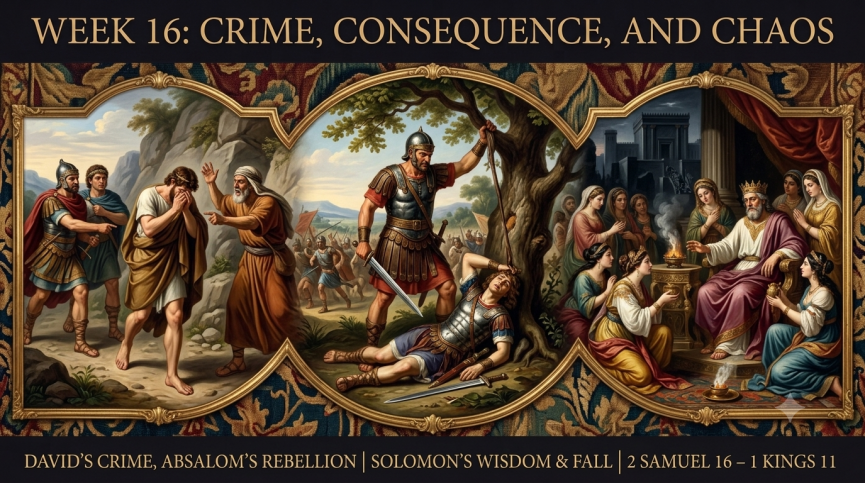
The Sum of It All
“Against you, you alone, have I sinned,
and done what is evil in your sight” (Psalm 51:4).
Why should there be such a disposition toward destruction, toward pain? I don’t understand this, but neither do I understand how I, myself, sometimes am my own worst enemy and why sometimes I willingly, irrationally bring pain to others.
—From Detective Stories From the Bible (2009); page 39
2 SAMUEL 16–18
Week 16, Day 1
How ironic that David, who once fled from Saul, now must flee from his own son! In light of David’s great capacity for human affection, it is especially sad that some of his most serious political problems arose in the setting of his personal relationships.
He retreats from his beloved capital and is strengthened soon by Ziba, the servant of Mephibosheth. Then he is cursed by Shimei, a distant relative of Saul who probably has waited for years for a chance to pour out his hatred on David. When a person is in retreat, he not only finds out who his friends are; he also discovers some people who have awaited the day they can speak a bitter word.
Meanwhile the political brain trusts are at work, in Ahithophel and Hushai. In spite of Ahithophel’s prestige, Hushai’s counsel—false advice, intended to aid David—wins; and the weight begins to go David’s way.
Again David is caught between public policy and personal affection. “Deal gently for my sake with the young man Absalom,” he appeals (18:5). But Joab is a tough-minded man with no room for sentiment or even for his king’s orders; and when the opportunity comes, he takes Absalom’s life. It is ironic, of course, that Absalom’s fall is because of his greatest pride, his wondrous head of hair. The revolt is over, but for David it is a bitter victory. He has lost his son.
PRAYER: Give mercy, I pray, for those persons in public life who are torn between personal loyalties and the general good; in Christ. Amen.
These chapters have to do especially with a series of intimate human relationships. What do they reveal about David the man?
2 SAMUEL 19–21
Week 16, Day 2
Joab, still the tough-minded politician, sees David courting even greater danger in his mourning for Absalom; and he was right, of course, in noting that David seemed to be moved by “love of those who hate you and . . . hatred of those who love you” (19:6).
So David took command of himself and of his kingdom and acted both wisely and compassionately. He granted mercy to Shimei (though he will revoke it on his deathbed) and did the best he could with the confusing reports from Ziba and Mephibosheth.
The rising controversy between Judah and the ten northern tribes is a rumbling that will become a full storm in the days of David’s grandson, Rehoboam. But Sheba’s effort is premature; and David is too strong to overthrow, even after the Absalom incident. And, of course, David has Joab on his side—the kind of man you may not always want with you but whom you surely don’t want against you. When the writer says of his killing of Amasa, “He did not strike a second blow” (20:10), he has given us a succinct summary of the decisiveness with which Joab did his work.
The vengeance granted to the people of Gibeon is a kind of civic fulfillment of the eye-for-eye, life-for-life rule. It also illustrates the sense of community that so characterized ancient peoples. A family or an extended family was both blessed and held guilty as a unit.
PRAYER: Make our nation sensitive, I pray, to decisions of the present generation that may burden succeeding ones; in Christ. Amen.
Joab is the essence of a tough-minded military man; at least one modern novelist has written a biography of David around him. What qualities of character do you find in him?
2 SAMUEL 22–24; PSALM 64
Week 16, Day 3
Since David is the sweet singer of Israel, it is appropriate that the heart of his story should conclude with a song—one that is also found in Psalm 18. Some of the lines reflect David’s experience as we have read it. When he says,
“In my distress I called upon the LORD;
to my God I called” (22:7),
we think of any number of instances that might have inspired such words. But when he says,
“The LORD rewarded me according to my righteousness; . . .
and from his statutes I did not turn aside” (22:21-23),
we’re not so sure. In any event, it is a great song of faith—and who am I to question another person’s testimony?
We wish David’s story might end with his song, but there is another deed to be done. David takes a census of the people. Joab, a hard man but full of insight, senses that his king is numbering the people for ego reasons. Perhaps it is because David feels his powers slipping from him as he recognizes that he is no longer the mighty warrior or the dominating leader. Whatever the motivation that makes him susceptible to temptation, he does wrong. He repents, but his people suffer. We human beings are bound up together in the bundle of life; when we do good, others are blessed, and when we sin, many suffer. No one lives to himself or herself, least of all a nation’s ruler.
PRAYER: Help me, dear Lord, to end my days singing your praise, rather than stepping over into paths of harm; in Jesus’ name. Amen.
Why, do you think, did David decide to take a census, against the advice of his trusted general?
1 KINGS 1–3
Week 16, Day 4
The old order passes, but not without some last gasps of distress. Once again David pays the price of his many marriages and his mixed-up family. This time it is Adonijah, a son whom David “had never at any time displeased . . . by asking, ‘Why have you done thus and so?’” (1:6)—that is, a spoiled child. Not surprisingly, he sees himself succeeding his father.
David keeps faith with Bathsheba, and with what he perceives to be the will of God, and makes Solomon his successor. But Adonijah doesn’t give up easily. Clever as well as handsome, he enlists—of all people—Solomon’s mother to plead his cause in a subtle move. Solomon sees through the plan, and Adonijah pays with his life.
This time Joab threw his influence in the wrong direction, supporting Adonijah’s cause. When Solomon orders his execution, he recalls that Joab has been a bloody man; now his bloody deeds come back on his own head (2:32). Having lived by the sword, he dies by it.
Much to his credit, Solomon realizes that the post he has inherited is too big for him. “Who can govern,” he cries, “this your great people?” (3:9). Given an opportunity to have what he will, Solomon asks for “an understanding mind to govern your people” (3:9). His request was itself an act of wisdom. Having asked unselfishly, he is assured by God that he will receive not only that which he has requested but all the other favors he might easily have sought.
PRAYER: Give me the wisdom, O God, to seek your best, knowing that if I do, other things will follow—and if not, they don’t matter. Amen.
We are always impressed by Solomon’s request for wisdom. But specifically, what personality factors are revealed in his prayer in 1 Kings 3:6-9?
1 KINGS 4–6
Week 16, Day 5
The writer is anxious for us to know the magnificence of Solomon’s lifestyle (4:20-28); we’ve come a long way from the early days of Saul, when he, as king, could be found following his oxen. Which goes to show that expanding government is not something our century invented.
Solomon’s wisdom, which “surpassed the wisdom of all the people of the east” (4:30), is measured not only by his writings but by his knowledge of nature (4:33). This reflects a world that lived closer to nature than ours does and whose idea of wisdom was far more basic.
Solomon sets out early to do the assignment especially given him by his father, the building of the temple. King Hiram is a proud associate in the effort. It is significant, of course, that the date given as the beginning of construction is numbered from the time the Israelites “came out of the land of Egypt” (6:1). The Exodus was their beginning as a nation; it was for them “the beginning of days.”
The detail of building that fascinates me most is the provision that all of the stone work shall be finished at the quarry “so that neither hammer nor ax nor any tool of iron was heard in the temple while it was being built” (6:7). There was to be a kind of reverent silence in the project. And Solomon is reminded that the purpose of this building is that the people will keep all the commandments so that God, in turn, can “dwell among the children of Israel” (6:13).
PRAYER: Dear Lord, help me to build the temple of my soul with all the intricate care Israel invested in its physical temple. Amen.
What can we learn from the rather complete report of Solomon’s building of the temple?
1 KINGS 7–9; PSALM 65
Week 16, Day 6
In his latter days, Solomon ceases to be the person he started out to be. I think the decline may have begun between 6:38 and 7:1, when we learn that Solomon spent seven years building the house of the Lord and thirteen years building his own house. If so, there is an application to all our lives.
Solomon’s prayer at the dedication of the house of the Lord could be a model for all dedicatory prayers. It begins with a recognition of the glory of God and acknowledges that no house is worthy of the Lord: “Even heaven and the highest heaven cannot contain you, much less this house that I have built!” (8:27). It portrays God’s house as a place where forgiveness can be sought (8:30-32) and where the nation can turn in times of defeat (8:33-34) or when there is drought, famine, or plague (8:35-40). There is gracious provision for the “foreigner [who] comes and prays toward this house” (8:42). And above all, a petition for times when we have sinned against the Lord—“for there is no one who does not sin” (8:46). And with it all, the remembrance that this is the One who “brought our ancestors out of Egypt” (8:53).
Whatever claim can be made for the wisdom of Solomon in his wise sayings, his remarkable decisions, his vast knowledge and learning, I will honor him above all for this, his prayer at the hour of dedication. In this moment, Israel was at her best: her king was her intercessor.
PRAYER: Week after week, as I enter houses dedicated to your name and glory, help me to sense the sacredness of the place; in Christ. Amen.
Solomon’s prayer at the dedication of the temple may have been his finest hour and perhaps the best declaration of his wisdom. What good things do you find in it (1 Kings 8:22-53)?
1 KINGS 10–11; PSALM 66
Week 16, Day 7
As the knowledge of Solomon’s wisdom spread, at last it reached the Queen of Sheba. She traveled a great distance in a time when travel was slow in order to “test him with hard questions” (10:1); and when she saw all the grandeur of his house and the excellence of his administration, she confessed that it exceeded even what she had heard (10:7).
But our most telling weaknesses seem often to be hidden in our strengths. Wise as he was, Solomon sinned grievously—and if we may say it, foolishly. He “loved many foreign women” (11:1), though he knew that they would incline his heart to follow their gods (11:2). As he grew old, his heart was turned by his wives to their gods; “and his heart was not true to the LORD his God, as was the heart of his father David” (11:4). As an old man he wanders from one pagan altar to another, following his wives. It is a tragic, pathetic sight.
As a result, enemies arose, such as Hadad and Rezon (11:14-25). But the worst would come in the days of Solomon’s son Rehoboam, through the hand of one of his own servants, Jeroboam. The prophet Ahijah told Jeroboam of the role he was to fill, taking ten of Israel’s tribes with him. When Solomon heard of the coming judgment of God via Jeroboam, he sought to kill him. Now we know how far from wisdom Solomon has gone, when we see him trying to subvert the judgment of God by seeking to destroy the agent of judgment. Thus ended Solomon’s reign of forty years.
PRAYER: Let me never forget, O Lord, that no wisdom is greater than that which keeps me close to you and your purposes; in Jesus’ name. Amen.
We go from a declaration of Solomon’s successes in 1 Kings 10 to his sad decline in 1 Kings 11. What several elements cause his departure from godliness?
Prayer Time
Let us pray daily for all who are in positions of authority, that they will accept the correction of God’s Spirit; and I will pray for myself, in this particular setting where I exercise authority:
How the Drama Develops 2 SAMUEL 16—1 KINGS 11
In these chapters we have seen the closing years of a great king, the promising beginnings for his son, and at last the sorry dissipation of those beginnings. We are tempted to character studies galore. There is the noble David, who spares Shimei (2 Samuel 19:18-23), and the petty David, who sees to it that he suffers later (1 Kings 2:8-9). A small-time malcontent, Sheba, tries to succeed where a far more able person, Absalom, has failed (2 Samuel 20). We hear David sing of the goodness of the Lord (2 Samuel 22), but we see him jealously measuring his power in a census of the people (2 Samuel 24)—then again, David’s essential nobility comes through in his passion to spare his people from judgment and to make a proper sacrifice to the Lord. And we have Solomon, already sensitive to the nuances of kingship in his rivalry with his half-brother Adonijah (1 Kings 1–2), but who realizes he needs more than native cleverness if he is to rule God’s people rightly, so he pleads for wisdom. He gets it and benefits mightily because of it. He becomes a hero to his ruling peers, who show their respect by lavishing favors on him. We read of his expanding kingdom, his great wealth, his proverbs and songs. We watch him spend seven years building the house of the Lord, which had been his father’s dream, and thirteen years building his own spacious dwelling. We see him at prayer, pleading for his people. He is a theologian who recognizes that “only you know what is in every human heart” (8:39) and also a psychologist who recognizes that “there is no one who does not sin” (8:46).
So how is it then that he could go so far wrong? How is it that he would love “many foreign women” (11:1) when all of the laws of his heritage forbade such relationships? Did he come to think that he was above the laws that governed the common people of his kingdom? Or was he too clever for his own good, marrying people of prominence in other kingdoms in order to cement political relationships? Or was it, perhaps, that the lively mind that wrote songs and proverbs was also a wide-ranging, restless mind that wanted to know how other people lived, and especially what attractiveness there might be in the women of other races? It is generally, you know, our strengths that cause us our greatest problems. Perhaps a less adventurous mind would also have been a less romantically curious one.
The Bible connects Israel’s two primary kings with poetry and music and wisdom. The Bible invites us to remember David and Solomon not only as regal administrators—or in David’s case, as a military genius—but also as men of worship and of literary instincts.
—From Heroes, Rogues, and the Rest:
Lives That Tell the Story of the Bible
(2014); page 69
However it was, Solomon comes to his last days a quite pathetic figure. He who had built a temple to the Lord God now built places to worship Chemosh, “the abomination of Moab,” and Molech, “the abomination of the Ammonites” (11:7). He becomes a doddering old man, fumbling his way from the altar of Astarte to that of Molech, while the temple of God is little more than a spiritual adjunct for his soul. And while he escapes with some poor shreds of royal dignity, he leaves behind the structures of disaster that will ruin the reign of his son. We know God became “angry” with Solomon, and told him so, but we have no report of Solomon’s response. Did Solomon care, or was he by now so taken with his pagan playthings that God’s displeasure hardly reached his ear? It is only “for the sake of my servant David and for the sake of Jerusalem” (11:13) that this once great king could die in peace. But I’m not sure he knew the difference.
Seeing Life Through Scripture
What might Solomon have learned from his father David that would have spared him the tragedy of his shameful end? We confessed earlier that David acted far from wisely in the latter days of his life, but his errors were more of degree than of direction. David’s loyalty to God remained the same; at no point was there even a hint of a leaning toward foreign gods.
That may well be the biggest single secret of David’s life. His position was defined the day he challenged Goliath: “I come to you,” he told the giant, “in the name of the LORD of hosts, the God of the armies of Israel, whom you have defied” (1 Samuel 17:45). I can think of no occasion when he wavered from this commitment. His ethics sometimes were uncertain, but because he was rooted in this divine commitment, he could repent of his ethical wanderings. I’m afraid Solomon didn’t have such a solid core of the utter singularity of the Lord God.
Nor did Solomon have a prophet like Nathan. Every king needs a prophet, just as every writer needs an editor. Indeed, every person needs a prophet, because all of us so easily wander from what is right. But kings (of whatever kingdom, large or small, political or business or professional) are especially in need of a prophet, because the more power we have, the more we need for someone to say, “Stop. Hear the word of the Lord.” I wish Solomon had had such a person.
Kalas, E. J. (2016). The Grand Sweep: 365 Days From Genesis Through Revelation. Abingdon Press.