
The Sum of It All
“Give your servant therefore an understanding mind to govern your people, able to discern between good and evil; for who can govern this your great people?” (1 Kings 3:9).
Week 17, Day 1
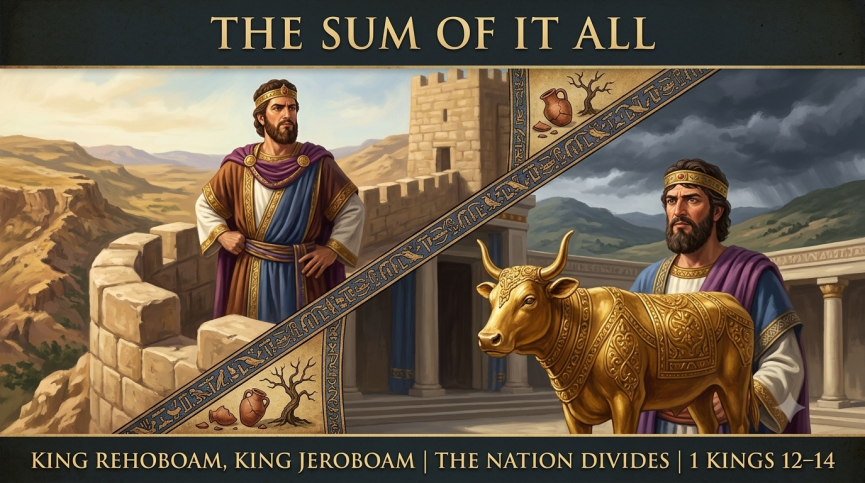
1 KINGS 12–14
The problems that began in the latter years of Solomon’s reign now reach full proportions under Rehoboam. Rejecting a chance to win the loyalty of the northern tribes, he chooses instead to reject them completely. At this point the nation divides, never to be reunited. The ten northern tribes will hereafter be known as Israel, while the two southern tribes, Judah and Benjamin (plus the no-count tribe of Levi), will be known as Judah.
Israel’s cause is just, and Jeroboam is a God-ordained leader; but he almost immediately takes a wrong turn. He thinks that if the people have to go to Jerusalem (capital of Judah) for their major religious festivals, he will not be able to hold their allegiance; so he turns to the familiar golden calf and, with a good eye for merchandising, places one in the northern extremity at Dan and the other to the far south in Bethel. Somehow Jeroboam couldn’t trust the God who raised him to power.
During the sickness of his son, Jeroboam made a tentative move toward God, but only for purposes of help, not for a change of life and direction. After twenty-two years as king he died, an adequate administrator but not a spiritual leader. Meanwhile, Rehoboam was doing no better in Judah, for “Judah did what was evil in the sight of the LORD” so that the people “committed all the abominations of the nations that the LORD drove out before the people of Israel” (14:22-24).
PRAYER: Help us, O Lord, in times of political change, to keep our eyes fixed steadily on you and your purposes; for Christ’s sake. Amen.
At what point in these chapters did Rehoboam go wrong, and at what point did Jeroboam do so?
Week 17, Day 2
1 KINGS 15–16; PSALM 67
This book and the three that follow, 2 Kings and 1 and 2 Chronicles, offer a rather relentless panorama of national tragedy, slipping back and forth between Israel and Judah in a way that can be both confusing and tedious to a casual reader. Nevertheless, some messages become clear. For one, Judah’s story is often relieved and redeemed, sometimes for a generation or more, by good kings; but Israel never has a good king. Not one. Also, notice that the quality of the rulers, as far as the biblical writers are concerned, is judged not by our usual contemporary standards, that is, not by their building programs, their legislation, or their economic policies, but by this measure alone—whether the heart is right with God.
In these chapters we see the first of a number of intermittent wars between Judah and Israel—civil wars, we might call them, since they are really one people. In Judah we are introduced to Rehoboam’s successor, Abijam, whose short reign is especially evil, then Asa, whose heart “was true to the LORD all his days” (15:14), forty-one good years.
In Israel, meanwhile, Nadab succeeds his father but reigns for only two years before he is overthrown by Baasha, who leads Israel for twenty-four evil years. His son, Elah, reigns only two years when one of his officers, Zimri, assassinates him and takes his throne. Zimri has just seven violent days and is replaced by Omri, who in twelve years “did more evil than all who were before him” (16:25). And still worse, Ahab is coming.
PRAYER: In evil times, O Lord, help me remember your mercy. Amen.
What things did Asa of Judah do that are described as “what was right in the sight of the LORD” (1 Kings 15:11)?
Week 17, Day 3
1 KINGS 17–18; PSALMS 68–69
Ahab and Jezebel are very bad news, but they are not all of the story. Quite out of nowhere (except the purposes of God) comes Elijah the Tishbite, one of the most remarkable characters in the Scriptures. We don’t know how long he was in God’s process of preparation or the nature of his training, but he appears with a bang and only once slips into a whimper.
While drought—announced by Elijah—is over the land, he lives first by the care of ravens, then by the kindness of the widow of Zarephath, for whom he works a miracle at the time of her deepest need. And then he challenges King Ahab (and even more directly, Queen Jezebel, whose prophets are brought to the showdown).
The scene at Mount Carmel is dramatic and, like much good drama, shot through with humor. Elijah mocks the prophets of Baal unmercifully, with scathing sarcasm; then, when it is clear they have failed, he calls the people to come closer to him while he repairs “the altar of the LORD that had been thrown down” (18:30). He builds in the symbolism of the tribes, reminding the people of their heritage, which had grown so dim in years of wicked leadership; then he heightens the drama by covering the area with water before calling down the fire. With vengeance he destroys the false prophets, then—without seeing a cloud in the sky—promises King Ahab that rain is on the way.
PRAYER: I want always to remember, O Lord, that whatever the headlines may be, you are at work, finding some Elijah; in Christ. Amen.
We read nothing of Elijah until he is introduced as a prophet of God. How do you explain the origins of such an earnest prophet in such an evil time?
Week 17, Day 4
1 KINGS 19–20; PSALM 70
Having won such a momentous victory, Elijah suffers post-triumph exhaustion. Fearless before hundreds of false prophets while a nation looks on, now he flees before Jezebel’s threats. God does not chide him or rouse him with superficial encouragements; he gives him sleep, a meal, still more sleep, and still another meal; then on to a cave, where Elijah reminds God how zealous he has been, how little good it has done, and how he is all alone in the battle.
God’s answer is both mystical and practical. On the mystical side, Elijah experiences the power of God in wind, earthquake, and fire and then in a “sound of sheer silence” (19:12). Again God asks Elijah what he is doing in retreat, and again Elijah offers his litany of despair. Now God outlines some practical details: Elijah is to anoint new kings for Aram and for Israel and a prophet—Elisha—who will eventually succeed him. And then, a correction of Elijah’s factual data: He had argued that he was entirely alone in his battle for God, but God’s records show there are “seven thousand in Israel, all the knees that have not bowed to Baal” (19:18). So Elijah offers his brusque call to Elisha, and a new prophetic chapter begins.
Meanwhile, Aram is attacking Samaria, headquarters of Israel. God blesses Israel’s defense in spite of Ahab’s disregard for his faith heritage. But even when blessed, Ahab fails to fulfill God’s purposes.
PRAYER: When I am tired, O God, give me the kindness you gave Elijah, restoring me by rest, food, and a revelation of yourself. Amen.
Why would Elijah be so disheartened in the wake of such a great victory?
Week 17, Day 5
1 KINGS 21–22; PSALM 71
The confrontation between King Ahab and Naboth might seem hardly a footnote in some national histories, but it is given a place of significance here. The incident demonstrates that in Israel the king was under the same law as were the people. Jezebel, with her pagan heritage, didn’t understand this; as a person of action, she took the law into her own hands, using her queenly power.
But the writer wants us to know that she will not get by with such conduct. The Hebrew Scriptures insist that there is order and justice in our universe; this theme finds expression in the deeds of history, the prayers of the Psalms, and the declarations of the prophets. In many different ways they remind us that judgment will fall on those who do wrong; there is a moral core to the universe, and we can depend on it.
There is also, however, a way of escape: repentance. Even the declarations of the prophets are subject to change if the objects of judgment are willing to change. When Ahab repented, wicked as he was, God postponed the judgment that had been announced (21:27-29).
We meet the prophet Micaiah only briefly (22:13-28) and wish we knew him better. He is a man of courageous convictions; one wonders how many others like him were pleading the cause of righteousness during the period of the kings without ever finding a place in the sacred history. Meanwhile, Judah’s good king Jehoshaphat dies, and Ahab is succeeded briefly by a son, Ahaziah, who follows in his parents’ footsteps.
PRAYER: Let me never forget that you are at work in your world. Amen.
What does the story of Naboth imply about the difference between the conduct of royalty in Israel and in Jezebel’s homeland?
Week 17, Day 6
2 KINGS 1–3; PSALM 72
Elisha knows that he is to succeed Elijah, but he intends to be more than a poor carbon. When Elijah asks him to stay behind, he refuses to do so; and when other prophets warn him that he will soon lose his mentor (and that he might as well therefore go his own way), again Elisha will not be dissuaded from his commitment.
His persistence pays off. Elijah asks what he wants, and Elisha boldly states it: “Please let me inherit a double share of your spirit” (2:9). As soon as Elijah disappears, Elisha puts his new role to the test: “Where is the LORD, the God of Elijah?” (2:14)—that is, now show me that I have what I’ve asked for! He gets his evidence, plus the witness of the other prophets (2:15).
Elijah was one of a kind (as we all are, though not usually so dramatically), so it’s hard to compare his ministry and Elisha’s. In sheer number of pages and listing of miracles, Elisha seems, indeed, to have gotten a double share of Elijah’s power. If so, he demonstrates the value of faithfulness. I don’t think he had the strong personality or the forceful leadership qualities of Elijah, but he was committed enough to God that he left what must have been a rather well-to-do home in order to follow Elijah and to serve him in a humble role. It is by that modest identity that he is recommended to King Jehoshaphat: “Elisha . . . who used to pour water on the hands of Elijah” (3:11).
PRAYER: May I always remember, O Lord, that any service done in your name is a high privilege, including the pouring of water. Amen.
What was Elisha’s secret in gaining the power that had marked the ministry of Elijah?
Week 17, Day 7
2 KINGS 4–5; PSALM 73
Like Elijah before him, Elisha seems sometimes to be so severe in his commitments as to be unapproachable. But here we see his tender side. He is a caring man as he deals with the poverty-stricken widow. The supply of oil lasts as long as there are vessels to contain it. The lesson? We might get more from God and from life if we expected more.
And then, the Shunammite woman who extends continuing hospitality to Elisha and his servant—so Elisha seeks to do a kindness in return. It is a very great favor, the birth of a son. But even life’s miracles are subject to the normal passage of time, which in this instance brought illness and death. Elisha shows not only great sensitivity in his concern for the woman but also persistence in getting an answer for her. I like the Elisha I see here.
He’s in his crusty mode in the Naaman story. Naaman is afflicted with leprosy, but an Israelite slave girl offers hope in a prophet back home. When Naaman arrives in the glory of a Middle Eastern procession, he expects a fitting reception. Instead, Elisha sends word by a servant that Naaman should bathe in the Jordan seven times. Naaman is offended; they have better rivers back home, and besides, he expected a bit of a ceremony. But a wise servant gently urges him to give it a try, and he is healed. Hail the heroes: an Israelite maid, a sensible servant, and the Jordan River. Paul might say that the cross is like the Jordan: foolishness until you give its power a try (1 Corinthians 1:18-25).
PRAYER: Dear Lord, may I never belittle the power of your grace. Amen.
Compare the miracles received by the poor widow and by Naaman; what characteristics might they have in common?
Prayer Time
Our times need some prophets. Here are some issues about which I will pray daily, because we need a prophet who can enunciate these concerns:
How the Drama Develops 1 KINGS 12—2 KINGS 5
As these chapters begin to unfold, it looks as if the drama has gone on hold. The nation of Israel was to have been God’s special instrument in the world, and now they are pathetically divided. At best, they were not a large or impressive nation; but now they are two small nations, neither one likely to be consequential in the affairs of state. We’re troubled too that the division is so unnecessary, that it could have been so easily avoided.
As the story continues, it grows still more dismal. The southern tribes (Judah) occasionally have a good king, but the northern tribes go from one poor king to another; the best are only inept, while the worst are masters of evil. Then comes King Ahab, who is evil enough on his own, but who is aided by the extraordinarily competent and dramatically evil Queen Jezebel.
But in the midst of all this potential despair, there is a ray of relief. His name is Elijah, and there is none other quite like him. He was not the first of the prophets, but he brought the role to such a new level that he is often seen as the first.
As a person, Elijah probably wasn’t an easy person to get along with. But all things considered, he had to be such a person in order to challenge kings and to stand alone against the several hundred prophets of Baal. Sometimes the best ends are achieved by thoughtful compromise. But in other instances, compromise is blasphemy. Elijah’s work was in the setting of this second category. For him, there was no middle ground. To have conceded good intentions on the part of his opponents or to have sought an area of negotiation would have been to betray the faith.
And with all of that, Elijah was classically human. He could be victimized by weariness and despair. But he did his work magnificently, then made an exit appropriate to his way of living. Also, he left behind an aide who was able to carry on his work. Elijah had so impressed this aide, Elisha, that he was not content simply to be a carbon of the towering figure with whom he had worked. Elisha wanted to be still more!
Without Elijah and the grand company of prophets, the plot line of our drama probably would collapse. They pestered and prodded rulers and people to be sure they didn’t lose sight of God’s calling and purposes. They were not always without fear; but when it came to a moral or spiritual showdown, they were ready for any confrontation, even death. The prophets were intensely personal, yet they spoke much of the time to whole kingdoms and generations. And although their basic call was to the people of Israel, they dared to speak to all of the neighboring peoples as well.
We remember Elijah mainly for his deeds, and for a few sharply phrased declarations that accompanied some of those deeds. But many of his colleagues over the several centuries left behind a literature of prophecy, and that literature continues to bless the world. The words of these prophets of Israel inspire visions of a better society and make us uncomfortable with the world as it is. And for Christians, of course, the prophets are significant above all else for giving us a profile of the Lord Christ and his kingdom. Without them, I repeat, the plot of our drama would collapse.
Seeing Life Through Scripture
Would we know a prophet if we saw one? Jesus rebuked the Jews for killing the prophets in one generation, then raising up a monument to them in the next. But would we do any better?
I am not suggesting that some modern personality might add to the canon of Scripture. But I wonder, first of all, if God does indeed use people in our day in special, incisive ways, to stir people to personal and social righteousness. For instance, did God use George Washington Carver in his generation to inspirit African Americans to work toward a better life—and then, in a more recent generation, did God use Martin Luther King, Jr., to stir the rest of America to see its sins against the African-American population?
And with that, I return to my earlier question: Would we know a prophet if we saw one? I don’t know if either of the persons I’ve mentioned were used of God as modern prophets, but I think probably some of us reacted to one name or the other—or even both!—in such a way as to indicate we would rule out some people before they had delivered the second paragraph of their message. I think we might find it quite difficult to hear the word of the Lord in our day unless the prophet spoke in accents and themes compatible with our personal philosophies. That’s why it’s hard to be a prophet. Or hard to hear one.
Kalas, E. J. (2016). The Grand Sweep: 365 Days From Genesis Through Revelation. Abingdon Press.