
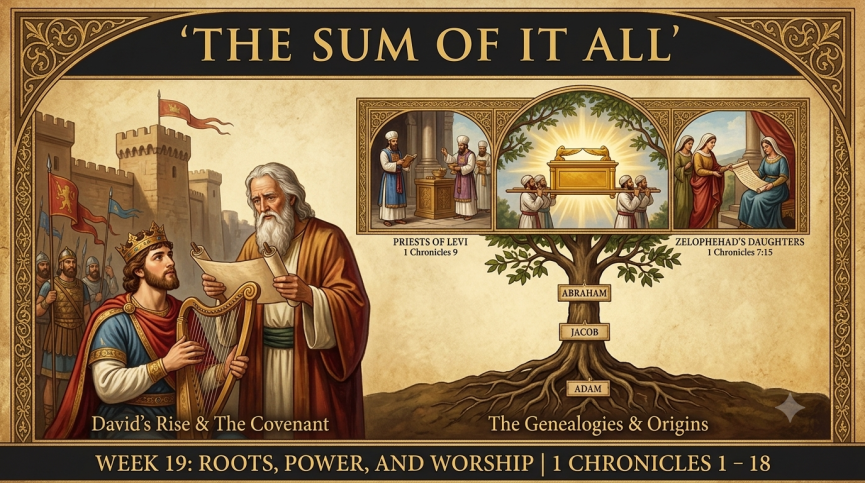
The Sum of It All
“Yet the LORD warned Israel and Judah by every prophet and every seer, saying, ‘Turn from your evil ways and keep my commandments. . .’ They would not listen but were stubborn, as their ancestors had been” (2 Kings 17:13-14).
Week 19, Day 1
1 CHRONICLES 1–3
For a modern reader, these chapters—and several yet to come—are as exciting as reading a telephone directory, and with hard-to-pronounce names at that. But several things need to be said. The records were more than simple genealogical pride; the genealogies were an expression of Israel’s sense of being the covenant people of God, and the record was particularly significant for members of the tribe of Levi to establish their right to serve at the altar.
One is impressed, too, that though the Israelites had strong convictions about their role as God’s unique people, they did not isolate themselves from the rest of the human race. The Chronicles record begins not with Abraham or Jacob but with Adam; and so, too, the “other lines” of the family are identified, such as the descendants of Ishmael and of Esau.
But especially, let it be noted that the Bible cares about people. We are important enough to be mentioned by name, one by one. To demonstrate our worth in God’s sight, Jesus said that “even the hairs of your head are all counted” (Matthew 10:30). In light of such a belief, surely names are consequential. In the biblical world, names were usually given on the basis of some special individual significance; and for that matter, still today a person’s name is a sacred possession. When the long lists of Chronicles are tedious, pause to thank God that biblical faith bothers to mention names. Individuals matter.
PRAYER: I thank you for my name; for me, it is special. Amen.
In only a few cases in these lists is a name accompanied by some anecdote. Comment on several of the most interesting people.
Week 19, Day 2
1 CHRONICLES 4–5; PSALM 77
There are occasional jewels hidden in these genealogical listings, some of them a kind of historical footnote and sometimes the making of a theological point. I pause, for example, at the mention of sons born to “Bithiah, daughter of Pharaoh, whom Mered married” (4:17), wondering how it was that a daughter of Pharaoh married an Israelite who was simply one of the company. Was she a faith convert, or was it romance?
The Chronicler is also an exhorter when he reminds us that several of the tribes won because “they cried to God in the battle, and he granted their entreaty” (5:20); on the other hand, some “mighty warriors, famous men, heads of their clans . . . transgressed against the God of their ancestors, and prostituted themselves to the gods of the . . . land” (5:24-25).
I especially like Jabez, with his two-verse biography (4:9-10). He brought particular pain at his birth, so that his mother named him Sorrowful. That’s not a pleasant name to carry through life, reminding you and all who meet you that you have been the source of sorrow to another. A name like that could give a person all kinds of complexes! Instead, Jabez was challenged by it. He asked God to bless him and enlarge his borders and “that you would keep me from hurt and harm.” And the happy fact is, “God granted what he asked.” Jabez saw no reason for suffering to continue and grow. He thought better of God and life, and he was right.
PRAYER: When I am inclined, O Lord, to let some discouragement be fastened to my life and outlook, remind me of Jabez; in Christ. Amen.
What was it about Jabez (1 Chronicles 4:9-10) that the Chronicler might have felt was praiseworthy?
Week 19, Day 3
1 CHRONICLES 6–7; PSALMS 78–79
There’s more than one reason to call David the sweet singer of Israel. Not only is he credited with writing so many psalms; he obviously encouraged music, as indicated by his naming a number of persons to be “in charge of the service of song in the house of the LORD” (6:31). All of us who appreciate sacred music can be thankful for the emphasis David gave it.
The phrase that appears repeatedly in 6:66-81, “with its pasture lands,” reminds us that, unlike American farmers, these people often lived in a village or city and maintained pasture land outside the town, just as centuries of other civilizations have done in subsistence farming. Such a structure provided security and community.
Remember our friend Zelophehad, who had only daughters, and whose daughters made a successful plea for their inheritance? We’re reminded of them again in this record (7:15). We’re reminded, too, unfortunately, that people sometimes won’t forget unpleasant facts about us. When the Chronicler gives Manasseh’s record, he notes that Asriel was born to Manasseh’s “Aramean concubine” (7:14). She did not have the status of a wife, though she surely fulfilled the functions and perhaps more, and she was also an outsider. One often hears such references in daily conversations: “That’s the baby that was conceived before they were married,” or, “He married out of his class, you know.” Lord, save us!
PRAYER: As I read the scores of names, I realize that each one represents some human story; I’m glad they all matter to you. Amen.
If you were assigned to do a paper on music in the worship in King David’s time, and your only data was 1 Chronicles 6:31-32, what spiritual, cultural, or ritual insights might you draw?
Week 19, Day 4
1 CHRONICLES 8–9; PSALM 80
Once again the Chronicler is both a theologian and a prophet, while letting us know why the genealogies are so important. We realize (9:1) that this book was written after Judah had returned from the Babylonian captivity and that the records were significant for establishing family lines as the people set out to re-establish their nation. And, of course, the whole historical record in Chronicles is important to a people whose identity might so easily have been lost during two generations of captivity away from their homeland.
But in any event, the writer wants us to know that “Judah was taken into exile in Babylon because of their unfaithfulness” (9:1). If some future generation were to conclude that it was only a matter of political movements and military power, the Chronicler has made the record clear: Judah’s troubles have a spiritual origin, in her failure to keep faith with the Lord God.
And since that’s the case, the eventual rebuilding of the nation (of which we will read, in time, in Ezra and Nehemiah) will depend very much on the leadership that the Levites will give. So we are reminded of certain of their duties. The chief gatekeepers (a role the psalmist would have cherished [Psalm 84:10]) are important because they must open the temple each morning; and important, too, are those who watch over the “holy utensils” (9:29) and those who make the flat cakes and bread (9:31-32). For all that happens in God’s house has its glory.
PRAYER: Remind me, O Lord, that whatever I do for you matters. Amen.
We’re inclined to think of the priests and Levites as leaders of ritual. What further insights on their work do you find in 1 Chronicles 9:14-34?
Week 19, Day 5
1 CHRONICLES 10–12
We return now to sacred history, the record of the dealings of God and the people of Israel. The period covered is the same as that in much of 1 and 2 Kings, but the particular writers have their own points of emphasis.
Most of us probably wonder at times why David, imperfect as he was, was nevertheless a person after God’s own heart. A major insight comes by way of contrast with Saul. The Chronicler summarizes the tragedy of Saul’s story by reminding us that “Saul died for his unfaithfulness; he was unfaithful to the LORD in that he did not keep the command of the LORD; moreover, he had consulted a medium, seeking guidance, and did not seek guidance from the LORD” (10:13-14). David did just the opposite. When he failed God, he sought heaven in repentance, readily changing his ways and starting anew. He sought not simply to avoid penalties but to bring his life into conformity with what he perceived God’s purposes to be. In our walk with God, the issue is not our falling down, but our getting up again; it is not our sins, grievous though they may be, but our readiness to turn from them and follow God’s way.
But David was not alone in his achievement. He drew to himself a great number of men of valor (among them, Uriah the Hittite [11:41]). They “kept coming to David to help him, until there was a great army, like an army of God” (12:22). At his best, he meant them to be that.
PRAYER: I learn many things, O Lord, from the lives of your saints, but especially this: When I fail, I will repent, and try again. Amen.
Chronicles covers essentially the same material covered in First and Second Kings, but it has its own points of emphasis. What hints do you have in 1 Chronicles 10:13-14 as to what they might be?
Week 19, Day 6
1 CHRONICLES 13–15; PSALM 81
We do well to look again at some of the qualities of David’s life that made him appealing in God’s sight. As David addressed himself to the nation, he reminded the people of the importance of the ark of God and of the fact that the nation “did not turn to it in the days of Saul” (13:3). The worship of God and the glory of God were primary issues to David. However uncertain his course may sometimes have been, his basic commitment was unerring; and it is for that reason that he was able, again and again, to find his way back to God.
He became angry with God for what he felt was an injustice against one of his soldiers, Uzzah, so that he “was afraid of God that day” (13:11-12). But again he showed the ability to correct himself. When he tried again to bring the ark to Jerusalem, he asked the priests to be the carriers, acknowledging that the tragedy that occurred the first time came “because we did not give it proper care” (15:13). This time the Levites carried it “as Moses had commanded” (15:15). Whatever else might be said about the incident, I am impressed by David’s readiness to learn from what he felt were his mistakes in the past. Life is a long learning process. That’s why saints grow slowly.
And again we note the unbridled joy David found in his walk with God. He had a “leaping and dancing” faith, which Michal not only could not understand but also despised. I wish, instead, she had watched and learned.
PRAYER: My pilgrimage with you is so long and sometimes faltering; help me, O God, to keep learning and following; in Christ. Amen.
The Chronicler gives us some details in 1 Chronicles 15:11-15 that are missing in 2 Samuel 6:12-13. What are they, and how are they significant?
Week 19, Day 7
1 CHRONICLES 16–18
Biblical religion has more of a celebrative quality than we sometimes seem to realize. Thus when the people come to Jerusalem to rejoice in the return of the ark, David distributes “to every person in Israel—man and woman alike—to each a loaf of bread, a portion of meat, and a cake of raisins” (16:3). It was a wondrous kind of communion service, so to speak. One can imagine the awe and joy the people felt as they returned to their homes to enjoy the foods David had distributed as his expression of joy in the presence of God.
As the Chronicler recalls David’s victories, he notes that “the Lord gave victory to David wherever he went” (18:6, 13). David, in turn, “administered justice and equity to all his people” (18:14); and when he came home, in ancient military fashion, with the spoils of battle, he chose to dedicate them to the Lord (18:11) rather than look upon them as his own possession. The movie Chariots of Fire, the story of a dramatic portion of the 1924 Olympics, comes to a climax when Eric Liddell, the devout Scottish athlete, refused to run in the qualifying race for his specialty because it came on a Sunday and to run would violate his faith. He was finally assigned to an unfamiliar length (400 meters). As the movie portrays it, a competitor gave Liddell a message as the race began. In truth it was given him that day by the team masseur. It read, “In the old book it says, ‘He that honors me I will honor.’ ” Liddell believed it that day. I think David lived by the same rule.
PRAYER: I want, dear Lord, to honor you in all I do; in Christ. Amen.
What do you know about David, as person and as ruler, from these three chapters?
Prayer Time
The Bible is so surely a book that lists names, thousands of them! I have new incentive to add these names to my daily prayer list:
How the Drama Develops 1 CHRONICLES 1–18
First and Second Chronicles cover much of the ground we have already been over in Second Samuel and First and Second Kings. Does that mean our plot line is on hold for these books? And if so, why bother with them?
I can’t say what was in the minds of the Jewish scholars who felt pressed by God’s Spirit to include the Chronicles in their canon, but obviously it was to them an argument too strong to be ignored. Clearly the writer of Chronicles drew upon material from Second Samuel and First and Second Kings, but also on other sources, such as Nathan, Gad (1 Chronicles 29:29), and Iddo (2 Chronicles 13:22). It seems quite possible that where First and Second Kings were written for the Jews in exile, the Chronicles were intended to strengthen the Jews after they had returned, as they worked to restore their homeland.
So while Chronicles covers territory we have already studied, it does so with its own focus and emphasis. It begins with Adam, and is at first only a collection of genealogies until the line reaches David. At that point, the story line takes over.
I think this arrangement indicates several things. For one, by going back to Adam, Chronicles reminded the Jews of their roots at the beginning of the human race. Second, with the genealogies coming to a focus in David, the people are not only reminded of their glory days under their greatest and most beloved king; they are also made to feel that history, beginning with Adam, was intended to come to its purposes and fulfillment in them.
The Chronicles begin with what seems an endless list of names. To us, tedium, but they were strategically important to the writer, and—he hoped—to his audience. For one thing, it was important to have a record of family lines in order to maintain what they perceived to be the purity of their people. For another, proper credit must be paid to the worthy souls of the past—not only mighty warriors, but also those who were responsible for the utensils and rituals of worship. If a nation is to regain its former glory, it has to recall those elements that once made it great. So too with the listing of towns that were associated with the several tribes. It is a way of declaring ancient ownership, a way of saying, “We were here long ago. We have been exiles for two generations, yes, but we have roots in this land, and it is ours.”
One marvels that the descendants of Jacob have managed, over scores of generations, to maintain a sense of family. Consider that for roughly twenty-five centuries they were without a homeland they could fully claim as their own, yet somehow they had a sense of nationhood stronger than that of many peoples who had land, people, and parliament. Many mystical and spiritual qualities have gone into this powerful sense of being a people, qualities that are not easy to measure or define. These burdensome lists of names have played a noble part in this sense of nationhood and destiny. It is one thing to say we are a people, and even to recite legends that glorify the heritage. But those legends have no substance until real names can be attached to them. Such is the role of the Chronicler. If it were not for such records, one wonders if the integrity of peoplehood could ever have been sustained.
Seeing Life Through Scripture
Genealogical research has become a major preoccupation in America in the past several decades. Not long ago, no one bothered seriously with looking into her or his past except those who thought perhaps they could trace their roots to an early American family or gain membership in some esteemed organization. But now vast numbers of people want to know where they’ve come from. Alex Haley’s book Roots greatly stimulated that new interest, so much so that when the last episode of the televised dramatization appeared, it drew one of the largest audiences in television history.
Why do we want to know? For most of us, such knowledge will gain us neither money nor social standing; we may even discover some branches on the family tree we wish had been lopped off. Why are we so curious about our origins? Why are those who have been adopted sometimes driven to learn their blood ties, even though they feel no one could mean more to them than the parents who raised them? What does it matter to know the names of someone five generations back? Isn’t it enough to know we belong to the human race, without identifying and tracing a particular branch? And does our ethnic heritage really matter? Am I more or less because I know the countries from which my ancestors came? Is there anything in most of us to compare with the Jewish passion for roots, and for nationhood? Why? Or why not?
Kalas, E. J. (2016). The Grand Sweep: 365 Days From Genesis Through Revelation. Abingdon Press.