
The Sum of It All
“He [the LORD] sent prophets among them to bring them back to the LORD; they testified against them, but they would not listen” (2 Chronicles 24:19).
Week 22, Day 1
2 CHRONICLES 29–32
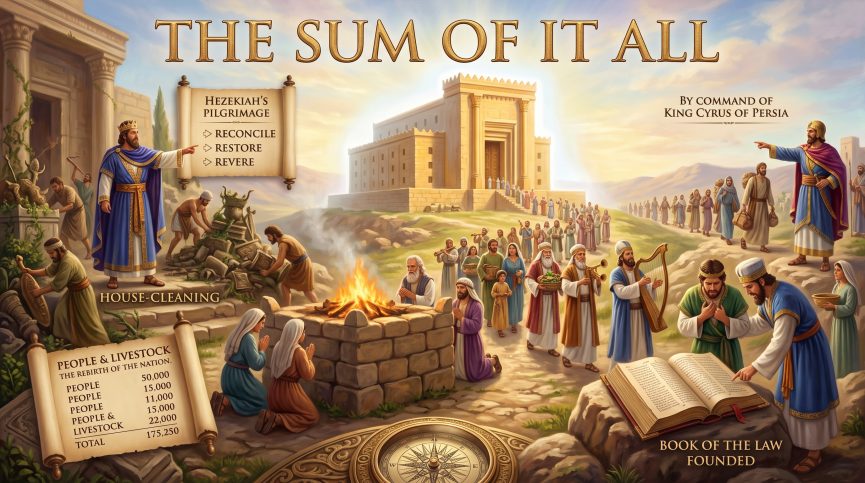
What do we do with the sins of our ancestors? It is quite easy to bewail them and it may satisfy the ego to do so, but no real good is accomplished. Hezekiah repented by turning Judah in a new way, beginning with a great housecleaning in the temple (29:16-19), then restoring temple worship. The Chronicler notes that “the thing had come about suddenly” (29:36), but I expect this was because Hezekiah was so much in earnest. In fact, he would not even let the religious calendar stand in his way. When there was not time enough to sanctify the priests before the traditional Passover date, they celebrated at a different time (30:1-4); and what they had in mind was so exciting they did their best to bring in all their kin from Israel, though not many accepted (30:10-11). Some who came hadn’t followed the established preliminaries, but Hezekiah prayed God would accept them “even though not in accordance with the sanctuary’s rules of cleanness” (30:19). Then Hezekiah cleaned out the accumulated pagan shrines and reorganized the priesthood.
When the Chronicler says that Hezekiah did these things “with all his heart” (31:21), we can believe it. His was no woeful shaking of the head about the past, but a vigorous beginning again. No wonder, then, that he was able to face the threatened invasion from Assyria, including a high-powered propaganda war. We’re sorry Hezekiah’s heart became proud in the midst of these achievements but glad that even then he was good enough to turn back once more to God (32:25-26).
PRAYER: Give me the courage, dear Lord, to clear away the past. Amen.
Summarize Hezekiah’s spiritual pilgrimage in three or four outline words.
Week 22, Day 2
2 CHRONICLES 33–34; PSALM 89
What perversity is there in human nature that Manasseh would want to overturn all the good his father Hezekiah had done? He was only twelve years old when his father died, so he had no remembrance of how bad things had been before his father’s reform; yet surely people must have told him. Perhaps it is simply that some of us insist on learning our lessons the hard way, from our own painful experience. In time, “bound . . . with fetters” by the Babylonians, Manasseh “humbled himself greatly before the God of his ancestors”; and God restored him. “Then Manasseh knew that the LORD indeed was God” (33:11-13). From that time on, he served God faithfully.
Amon, his son, didn’t do so well. He didn’t get time to learn from experience, because after only two evil years he was killed by his servants. That’s the trouble with learning by experience; sometimes we don’t get to finish the course.
But Amon’s son, Josiah, did well. Only eight years old when he was thrust into power, “while he was still a boy, he began to seek the God of his ancestor David” (34:3). By the time he was twenty, he was purging his country of its idolatry; and at twenty-six he began a campaign to repair the temple. It was at this point that Hilkiah found the lost book of Law. When Josiah heard the words of the Law, “he tore his clothes” in anguished sorrow (34:19) and began renewing the divine covenant (34:31).
PRAYER: As I see some follow your ways and some reject them, I realize anew that I must choose you for myself. Help me, I pray. Amen.
Choose one word to describe each of the three successive kings Manasseh, Amon, and Josiah.
Week 22, Day 3
2 CHRONICLES 35–36; PSALM 90
This section begins with a wondrous celebration of the Passover—“No passover like it had been kept in Israel since the days of the prophet Samuel” (35:18)—but in a very special sense it becomes a transition to a new day when there is an emphasis in God’s use of Gentiles for his purposes.
The first instance is King Neco of Egypt, against whom Josiah went to battle. Neco didn’t intend to fight Josiah but insisted that his mission was at God’s command. Other pagan kings had said such things, but in Neco’s case it was so (35:22); unfortunately, Josiah failed to recognize it and lost his life in a battle against Neco.
Then there is Nebuchadnezzar, king of Babylon. For generations the people of Judah had broken their covenant with God; and though God spoke “persistently to them by his messengers, . . . they kept mocking . . . , despising his words, and scoffing at his prophets” (36:15-16). So at last, judgment must come, and for it God employs Nebuchadnezzar (“Therefore he [God] brought up against them the king of the Chaldeans” [36:17]).
And when at last the captivity comes to an end, again it is a Gentile ruler—this time, King Cyrus of Persia. In the first year of his reign, “in fulfillment of the word of the LORD . . . the LORD stirred up the spirit of King Cyrus” (36:22). With the voice of an evangelist, he calls God’s people to return to their homeland. A new day has come.
PRAYER: Thank you, Father, for using such varieties of people for your purposes. Help me, in time and place, to be willing. Amen.
Ponder the failure of Judah’s last kings, and God’s employing a foreign king, Cyrus, to fulfill the divine purpose; what are your thoughts about these developments?
Week 22, Day 4
EZRA 1–3
King Cyrus, confident that God has ordained him to build a temple in Jerusalem, issues an invitation to the people of Judah and Benjamin; and “everyone whose spirit God had stirred” (1:5) accepts the call. Cyrus shows remarkable commitment to his mission by being certain the vessels of the old temple, still available after two generations, are sent back for this new house of God.
Again we are given a long list of names. They are important because this is the rebirth of the nation and a record must be kept. We’re also given a report of their resources, as measured primarily in livestock; and with all of that, a report of their “freewill offerings for the house of God” (2:68). At best they had to be a subsistence people as they set out to rebuild a country that had been relatively undeveloped for so long, but their generosity was great.
Their first act was to build an altar. We can easily forget it, but all of worship is built around the point where we make our commitments and our sacrifices to God. The foundations of the temple itself were not laid until months later.
The completed foundation was reason for celebration, with trumpets and cymbals and the resounding singing of the “steadfast love [that] endures forever” (3:11). The new generation simply shouted for joy, but those who remembered the old temple “wept with a loud voice” as they saw the beginning of a new house (3:12-13).
PRAYER: Thank you, Lord, for new starts in life! Whatever they may be, I want to build them around your altar; in Jesus’ name. Amen.
What is the significance of the statistics of people and livestock in Ezra 2?
Week 22, Day 5
EZRA 4–6
Only rarely does a good cause proceed long without opposition. In this case the opposition came from some other inhabitants of the area who at first feigned sympathy but who, when their plan was rejected by Zerubbabel and his council, undermined them in the court of the king of Persia. They convinced King Artaxerxes to stop the building program. But in time the prophets Haggai and Zechariah stirred the people to action once again so that they once more began building, even without permission.
Now a showdown came. The Jews asked King Darius to search the records so he might see that they had been empowered long before by King Cyrus. When the records were found, Darius ordered that the work should go forward without hindrance: “Let the work on this house of God alone; . . . I, Darius, make a decree; let it be done with all diligence” (6:7, 12). So the people completed the work on the house of God, “by command of the God of Israel” and by decree of the kings of Persia (6:14).
This is a remarkable development, a miracle in its own right. Why would the chief of state of what was then the world’s greatest power show such respect for the God of Israel? They were a downtrodden people who hadn’t held a major place in political history for a number of generations. Why did the king feel that the God of a recently captive people could be a God of power whose wishes were significant?
PRAYER: I’m very grateful, O Lord, that you work in the hearts and minds of some who might not seem naturally sympathetic; in Christ. Amen.
Now another non-Israelite king, Darius, helps the cause. Recall earlier instances when foreign rulers assisted the people of God.
Week 22, Day 6
EZRA 7–8; PSALMS 91–92
A great many years—probably as many as sixty—elapsed between the events at the beginning of this book and the appearance of Ezra, the man whose name it bears and who is traditionally thought to be the author. During those intervening years, deterioration had set in. The original fire of commitment had died, and the people were accommodating themselves to the pagan cultures around them.
Ezra was a different breed. He had “set his heart to study the law of the LORD, and to do it, and to teach the statutes and ordinances in Israel” (7:10). One marvels that he possessed such an earnest commitment. The people had been isolated from their spiritual and theological roots for generations; why would he conclude that the Law of the Lord was important enough that he should dedicate his whole being to studying and teaching it? When you answer this question for Ezra, you probably have an insight to explain all the other renewals of biblical faith that have occurred over the centuries, including such persons as Francis of Assisi, Martin Luther, and John and Charles Wesley. In repeated instances remarkable people have arisen on the spiritual landscape at times when one might conclude that the cause is lost. Such was Ezra.
The king believed in him, and he believed in God. When he wavered at the hazards of a dangerous journey, he confessed that he “was ashamed to ask the king for a band of soldiers” when he had told the king God would take care of him. So he fasted and prayed and moved with courage (8:22-23)!
PRAYER: Thank you for sending light in the midst of dark times. Amen.
Describe Ezra’s spiritual qualities, as revealed in these two chapters.
Week 22, Day 7
EZRA 9–10; PSALM 93
A modern reader is inclined to see Ezra as a bigot in this report of his handling of the mixed marriages into which the people had entered. He is unbending, no doubt about it, and he offers no compromise. But let’s see if we can understand him from something other than our own vantage point.
We should note, at the outset, that the issue was a spiritual, not a racial or ethnic one; he was committed, in the tradition of Israel, to religious purity. We should also remember that restrictions against mixed marriages were common in many cultures at that time.
I’m also impressed by the intensity of Ezra’s suffering over the issue: “I tore my garment and my mantle, and pulled hair from my head and beard, and sat appalled” (9:3). Probably one element that bothered him most is that a number of the offenders were major persons: “in this faithlessness the officials and leaders have led the way” (9:2). Of the 113 men with foreign wives, 17 were priests and 10 were Levites. It is as if they judged themselves to be above the law of the common masses.
We should also see the matter in the context of their history. Israel had been called to be a separate, holy people, with practices that were dramatically different from those of the nations around them. Instead they had failed repeatedly. Now God had restored them for another chance; but instead of responding with high commitment, they were sinning just as their ancestors had. A severe remedy was needed, and Ezra gave it.
PRAYER: Help me, O God, to follow you with passionate devotion. Amen.
With whom did Ezra begin his actions of reform?
Prayer Time
Perhaps we should sometimes read history on our knees, so to speak.
Meditate before God on the instances in personal or community history when you think God may have been at work.
How the Drama Develops 2 CHRONICLES 29—EZRA 10
In these chapters the slippery slide comes to its dismal end—and then, thank God, things take a new turn. At first, there is great hope. Hezekiah offers all kinds of promise. He reopens the gates of the temple, begins a vigorous campaign of cleansing and reform, then rededicates the temple to the worship of God. Then, a grand, delayed celebration of Passover. The king even sends messengers to the former Northern Kingdom, inviting people to come to Jerusalem for the event. A few from the tribes of Asher, Manasseh, and Zebulun “humbled themselves and came to Jerusalem” (2 Chronicles 30:11). Small as this response might have been, it was an impressive sign of renewal.
So many things about Hezekiah were right, but later he proved disappointing. His son Manasseh, in a long, fifty-five-year reign, undid much of the good his father had done, even building pagan altars in the temple and causing his son to pass through fire in an evil ritual of sacrifice. Eventually he repented and tried to re-institute reforms, but evil is more easily done than undone, and some elements of loss were never restored. Still worse, Manasseh’s son Amon chose to follow his father’s earlier, evil practices for a brief, disastrous two-year period.
And then, a kind of last hurrah with young King Josiah. While “still a boy, he began to seek the God of his ancestor David” (34:3), and as a young man he cleansed Judah and Jerusalem of the high places and various other abominations. His reforms even carried into many towns of the former Northern Kingdom. Then, in the eighteenth year of his reign, the biggest step of all, when the priest Hilkiah came upon a book of the Law—probably Deuteronomy. This sparked still greater reform.
As we know from our reading of Kings, the reform didn’t last much beyond Josiah; I think we must conclude that the momentum of evil was simply too pervasive. We read the sorry stories of Jehoahaz, Jehoiakim, and Zedekiah and see the several Babylonian invasions. Chronicles goes a step beyond Second Kings, however, and reports the edict of King Cyrus of Persia: He will build a house for God in Jerusalem. “Whoever is among you of all his people, may the LORD his God be with him! Let him go up” (2 Chronicles 36:23).
And that’s where the Book of Ezra picks up the story. A group of Jewish exiles accept Cyrus’s challenge—heads of clans from the tribes of Judah and Benjamin, priests and Levites, “everyone whose spirit God had stirred” (Ezra 1:5). They must have made a strange procession, but they had a mission: They were going to rebuild the temple in Jerusalem. And they had the help and prodding of two prophets, Haggai and Zechariah. No wonder they finished what must have seemed an impossible task.
Ezra, “a scribe skilled in the law of Moses” (7:6), now led another group of exiles to Jerusalem. But all was not well. He discovered the Jews had intermarried freely with the people whose religious and ethical practices were an abomination to Israel. Ezra was so distressed he “sat appalled until the evening sacrifice” (9:4). His remedy was quick and severe. From a distance, it seems bitterly severe, but hard decisions cannot always be understood from a distance.
Seeing Life Through Scripture
Does God work in the midst of human history? Is it true, as the poet says, that “behind the dim unknown” God is on the throne, touching and sometimes shaping events? The writers of Second Chronicles and Ezra had no doubt of it, nor did numbers of the Hebrew prophets. They were utterly sure God was interested and involved. Indeed, the various psalmists sometimes complained when it seemed to them God had removed himself from their history.
So when King Cyrus of Persia does a quite unlikely thing, and sends a herald throughout his kingdom to urge the Jews to return to their homeland and build a house of worship, the Chronicler says it is “in fulfillment of the word of the LORD spoken by Jeremiah” and that Cyrus is doing what he is doing because “the LORD stirred up” his spirit (2 Chronicles 36:22). Later, when some enemies try to disrupt the building program, King Darius comes to the defense of the Jews so the building can go on.
Was God so at work in human history? Or were the Old Testament writers spiritualizing a natural human process? And to come to our own day: Does God become involved in our history at times? If so, under what circumstances? Have there been any recognizable instances in the twenty-first century? One way or the other, how do you prove it?
Kalas, E. J. (2016). The Grand Sweep: 365 Days From Genesis Through Revelation. Abingdon Press.