
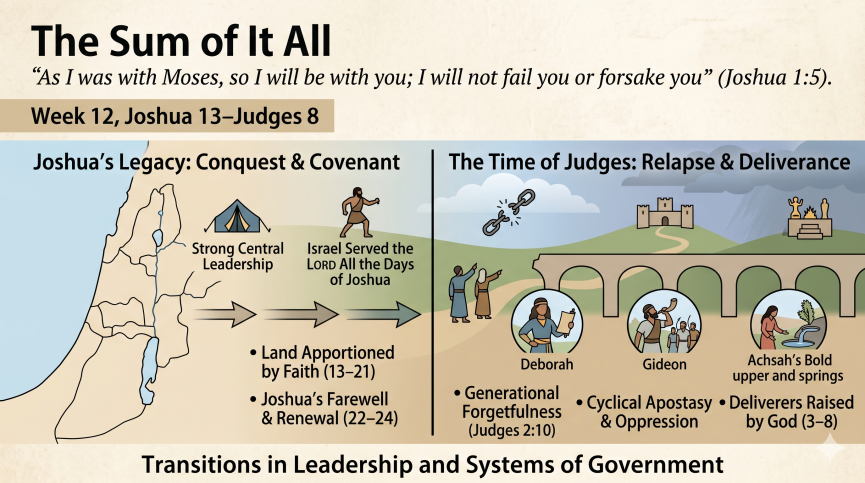
The Sum of It All
“As I was with Moses, so I will be with you; I will not fail you or forsake you” (Joshua 1:5).
JOSHUA 13–15
Week 12, Day 1
In the midst of what might seem a rather tedious geography lesson, we are re-introduced to that doughty man of faith, Caleb. As he looks back on the events forty-five years before, he sees the report that was then controversial as nothing other than good sense: “I brought him an honest report” (14:7). When one views life with faith, one sees a logic in the data that another might miss.
His zeal has not been diminished by the years. He has grown old victoriously. “I am still as strong today as I was on the day that Moses sent me” (14:11). So much so that he wants to take on another challenge: Show me the Anakim and their fortified cities “and I shall drive them out, as the LORD said” (14:12). Faith gives a zest for life. For Caleb life has always been a matter of advancing, not retreating.
It seems his daughter Achsah was made of the same stuff. When he gave her to the man who would attack a certain city (it seems Caleb wanted a son-in-law of his own kind!) and Othniel claimed her, Achsah dared to ask for more. What good is land in the Negeb without a spring of water? she asks. So Caleb gave her upper and lower springs—more, I think, than she sought. Himself a person of vigor, he was proud to see his daughter take hold of what life proffered and reach out for still more. And that, too, is the style of faith.
PRAYER: Sometimes I sell you short, O Lord, by selling myself short. Give me a grand zest for life, I pray; in Jesus’ name. Amen.
What significance do you see in the fact that the Levites owned no land and had no inheritance?
JOSHUA 16–18
Week 12, Day 2
When a baseball, football, or basketball season is about to begin, you’ll hear a coach say of a particular player, “The position is his to lose.” That is, in the competition for a position, this person is already considered the winner; if he doesn’t get it, it’s his own fault.
That’s the way Joshua deals with the tribe of Joseph and later with seven other tribes in the apportioning of land. Joseph—that is, Ephraim and Manasseh—complain that they haven’t been given a portion in comparison with their size and strength; and Joshua answers, “If you are a numerous people, go up to the forest, and clear ground there for yourselves” (17:15). It’s theirs if they will go and get it!
So, too, there were seven tribes “whose inheritance had not yet been apportioned.” It seems they were sitting back, waiting for something good to happen to them. Joshua asked, “How long will you be slack about going in and taking possession of the land that the LORD, the God of your ancestors, has given you?” (18:3). He instructed them to send a delegation to write out a description of the land and its boundaries, and he promised that he would divide it. Then, however, it would be their responsibility to get it. So it is with the promises and blessings of God. They’re there for us, but we have to take hold of them.
PRAYER: I wonder, O Lord, how many blessings I have missed because I didn’t “rise up to take the land”? Help me, I pray; in Christ. Amen.
How do you explain the reluctance of Israel to finish settling in the new land?
JOSHUA 19–21; PSALM 55
Week 12, Day 3
At this point in its history, Israel was a theocracy—a nation ruled by God. When the territory was divided among the tribes, it happened therefore “at Shiloh before the LORD, at the entrance of the tent of meeting” (19:51). As with all of Israel’s experiences, it was a religious event. Because Israel was a theocracy, all of their history was sacred history.
So, too, when the dividing of the land was complete, the writer reminds us that Israel had received everything the Lord had promised and that now they would enjoy “rest on every side”; again, just as it had been promised. “Not one of all the good promises that the LORD had made to the house of Israel had failed” (21:45).
But perhaps you still ask yourself why you should have bothered to read these several chapters that list in such detail the division of the lands, especially when they seem repetitious and overly precise. In a sense, the answer is like climbing Mount Everest: because they’re there. That is, they’re part of the Bible. It’s true that Jesus never quoted from them in the Gospels, nor did Paul in his epistles. They don’t have the quality of the Psalms or of Isaiah. They do, however, belong to the sacred canon, and in reading these portions we come to a more intimate sense of knowing the people of Israel.
PRAYER: Help me to know, dear Savior, that your promises to me are as sacred as those made to Israel. I can count on you; in Christ. Amen.
What would be our closest legal equivalent to the cities of refuge?
JOSHUA 22–24
Week 12, Day 4
Both Old and New Testaments teach against solitary religion. Israel understood that it could not maintain its spiritual purity and strength if it became divided; so when it appeared that Reuben, Gad, and Manasseh were isolating themselves, the other tribes responded with alarm (22:1-34). In the same mood, Joshua appealed to the people to maintain their racial unity lest they lose their spiritual unity and commitment (23:1-13). They were to be the people of God, corporately as well as individually.
Joshua’s farewell is a challenge, as impassioned in its own way as was that of Moses before him. He reminds the people again that God has worked miracles on their behalf in bringing them out of slavery to the land of promise. So now, “choose this day whom you will serve . . .; but as for me and my household, we will serve the LORD” (24:15).
We are tempted, as was Israel, to have a comfortable religion, without too many demands and with a casualness that allows us to go in and out as our mood directs. But gracious as God is, he will not be mocked. There is a time when we must say, “As for me, I will serve the Lord.” And we say it not only once, in a moment of climactic decision, but daily, sometimes hourly, through hundreds of little choices.
PRAYER: Forgive me, dear Lord, if sometimes I treat you in casual fashion, forgetting your majesty and honor; in Christ’s name. Amen.
Why did Joshua have so much easier a time than Moses in leading Israel?
JUDGES 1–3
Week 12, Day 5
It is always difficult to live up to our occasions of high decision. Perhaps no book of the Bible makes that point more directly than Judges. The people worshiped the Lord as long as there were those who could recall the miracles of the days of Joshua (2:7), but then came another generation “who did not know the LORD” (2:10).
The problem was no doubt accentuated by the weakness of the political structure under the judges. But all through this book the plot line is the same; 2:18-19 summarizes it perfectly. When a judge, raised up by God, delivered the people from the hand of their enemies, the people served the Lord—usually as long as that judge lived. But as soon as the judge died (and sometimes before) “they would relapse . . . , following other gods” (2:19). And despite all the warnings of Moses and Joshua, and all of the people’s earnest vows of purity, they soon intermarried with the foreign peoples living among them and began to take on their pagan religious practices.
So we begin a series of fascinating but essentially tragic stories. The lead characters change—Othniel, Ehud, Shamgar—but the plot remains the same. The people forget God until they are in trouble; then they repent and God sends a deliverer; but as soon as their fortunes are secure, once again they forget God, and the whole dreary scenario repeats itself.
PRAYER: I’d rather not have to repeat my poorest lessons, O Lord; help me, I pray, to learn well the first time; in Jesus’ name. Amen.
What seems to indicate a predictable time line in the apostasy of the nation following the death of Joshua (Judges 2:6-10)?
JUDGES 4–5; PSALMS 56–57
Week 12, Day 6
How does one explain a woman like Deborah? At a time when everything about the culture fenced women in, how is it that this woman was both a prophetess and a judge in Israel? She was obviously tremendously gifted, and she was courageous. She dared to challenge Barak to lead the troops; and when he answered that he would do so only if she would go with him, she let him know that the victory would come through the hand of a woman. Perhaps credit should also be given to Barak for his readiness to accept leadership under such circumstances.
The troops of Israel were wonderfully victorious, but the climactic blow came through the hand of a woman who was not even an Israelite. As is often the case through the Old Testament Scriptures (one thinks immediately of Rahab and much later of Cyrus, king of Persia), an outsider becomes an instrument of God to help the people of God.
Not all of Israel did as well. When Deborah and Barak joined for their victory duet, they noted that some of the tribes—Reuben, Gilead (Gad), Dan, and Asher—held back. But where they failed, nature itself was enlisted on Israel’s side:
“The stars fought from heaven,
from their courses they fought against Sisera.
The torrent Kishon swept them away” (5:20-21).
It was a great day of victory, and it brought peace for forty years.
PRAYER: I want to stand with you, O Lord, in the battles between right and wrong; give me always the courage of high convictions. Amen.
What sense do you get of regard for Deborah’s leadership in the exchange between Deborah and Barak?
JUDGES 6–8
Week 12, Day 7
Gideon is one of God’s unlikely servants. When he was called, he protested that his clan was the weakest in his tribe and “I am the least in my family” (6:15). He fulfilled his first assignment of leadership, but he did it by night “because he was too afraid . . . to do it by day” (6:27). And when God called him to further action, he asked for a sign, and then a second sign (6:36-40).
But once he got started, there was no stopping him. He dared even to cut his army to ridiculously small proportions in obedience to God’s command, and he led them to victory in one of the most memorable Old Testament stories.
Power and success are heady stuff, however, and Gideon didn’t handle them well. When the people asked Gideon to establish a family dynasty, he refused, insisting that only the Lord would rule Israel (8:23). But then he collected gold from the people and made an ornamental garment, which became to the people a graven image—the very evil from which Gideon had first been called to deliver Israel. “It became a snare to Gideon and to his family” (8:27); and no doubt it prepared the way for the worship of Baal, which was revived soon after his death. The people soon forgot both God and the house of Gideon (8:34-35). There is usually a close tie between our gratitude to people and our gratitude to the Lord God. Forgetting one, we’re likely to forget the other.
PRAYER: Help me, I pray, to remember your kind works in my life, and also those persons through whom your kindness is extended. Amen.
What is the strength of Gideon’s character that made him an effective leader, and what weakness finally caused his downfall?
Prayer Time
I will pray daily for these persons who don’t know their potential for leadership:
I will pray daily for better understanding of my own divinely ordained gifts.
How the Drama Develops JOSHUA 13—JUDGES 8
Our drama takes quite a different turn as we move from the conquests of Joshua to the period of the judges. Here we have a transition not simply of leadership but of entire systems of government. And in the changes, we see some developments, both negative and positive, in the character of the people.
Joshua had been a very strong leader. Even so, when he died, the people had not yet taken all the territory they had envisioned. They continued their conquest on a tribal basis more than as a unified nation. This probably led to a weak central government, one that for all practical purposes may have functioned only in times of war. Nor was there a leader of Joshua’s ability waiting in the wings to succeed him.
The writer of the Book of Judges puts the matter succinctly: “The people worshiped the LORD all the days of Joshua, and all the days of the elders who outlived Joshua, who had seen all the great work that the LORD had done for Israel” (Judges 2:7). But then there came a generation “who did not know the LORD or the work that he had done for Israel” (2:10). And thus began the political and spiritual roller coaster that is the Book of Judges.
If this is to be the nation that will be the witness of God to the world, it’s hard to recognize it in the period of the judges. To use a biblical phrase, they are as unstable as water. Their history is in a cyclical pattern: They are strong and comfortable; they forget the Lord; they are defeated by their enemies; they cry for help; God sends a deliverer; they are strong and comfortable; and on and on! It is a dreary picture, not only as national history but in what it reveals about human nature.
Of course, it’s instructive that the nation’s political fortunes rise and fall with its spiritual well-being. Not immediately. There’s always a lapse of time, as if the season were catching up with the calendar. But as the spirit of the people goes, so goes the welfare of the nation.
Here is something of the wonder of faith. It is as good in the night as in the day, in economic depression or prosperity, in failure or success. It is perfect to live by and indispensable to die by.
—From Faith From the Back Side: A
Different Take on What It Means to
Believe (2011); page 109.
With it all, we are introduced to some fascinating characters. None can be compared with Moses or even Joshua, but each is significant for his or her own time. Take Deborah and Barak—and it isn’t just pleasant sound that makes us put the names in that order. They form a powerful team, with Deborah obviously a strong leader and Barak wise enough to let her take the lead. Then there is Gideon, an enigmatic character, at first so humble that we think he will never assume his mantle of leadership, and so fearful that he does his first act of leadership by night lest he be discovered. In the later years of his career, he becomes so presumptuous that he establishes a false idol for worship.
But at the height of his leadership, he was memorable! What can compare with his battle with the camp of Midian, when he leads a band of three hundred against vastly larger forces? From a spiritual point of view, it is a victory of faith, and the New Testament writer will recall it as such (Hebrews 11:32-34). But from a human point of view, it is almost as notable for its sheer audacity. And perhaps the deeds of faith often look like nothing other than audacity to those who observe from the outside. Faith deeds are best interpreted by faith eyes.
Seeing Life Through Scripture
How much of the human story is to be attributed to the work of the Holy Spirit, and how much to dynamic human leaders? Can the purposes of God be fulfilled if there is no Moses, no Joshua? Does history sometimes lag behind God’s will because there is no person in reach whose heart is great enough to do God’s calling?
Or can the Spirit of God transform any poor stick and make it a rod of power? Would Gideon ever have been anything more than a somewhat bumbling farmer if the Spirit of God had not come upon him? What is the junction at which God’s Spirit and our human talents meet? Is the potential of greatness truly in every human being, waiting to be set free; or is that pep-talk stuff?
My son once asked, as he recalled clergy conversations he remembered from his youth, if it was simply that there were giants in the land in those days. I replied that, according to my recollections, the giants had been a generation earlier. Does it seem that way because our memory plays such tricks on us? Partly perhaps. But it is also partly because we don’t usually recognize the giants until the Spirit of God has grown them to full size, and that tends to be a slow process. That’s a fact to be remembered as we view our own lives. We can’t imagine what size person God would grow within us, given the chance.
Kalas, E. J. (2016). The Grand Sweep: 365 Days From Genesis Through Revelation. Abingdon Press.