
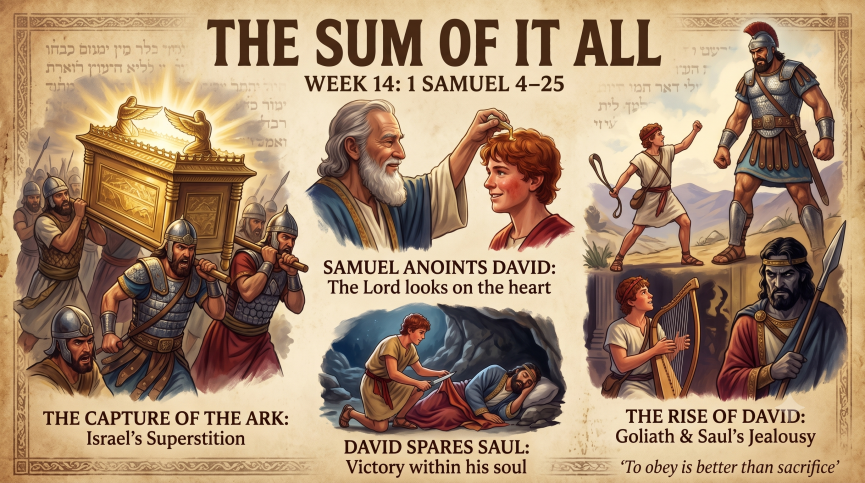
The Sum of It All
“The women of the neighborhood gave him a name, saying, ‘A son has been born to Naomi.’ They named him Obed; he became the father of Jesse, the father of David” (Ruth 4:17).
1 SAMUEL 4–6
Week 14, Day 1
The focal point—one might even say the hero—of these chapters is not a person but an object, the ark of the covenant. For Israel, it was visible evidence of their covenant with God and of God’s commitment to be with them and preserve them. But it was never meant to be a magic object; and, unfortunately, Israel came to reduce it to such. Having lost a battle with the Philistines, they concluded that if only they would carry the ark with them, they would win. It would be their magic charm.
Instead they lost, and lost horribly, with Eli’s two sons killed in the battle and the ark taken hostage. To understand how crucial the ark was in Israel’s thinking, notice that it was the news of the ark, more than the death of his sons, that caused Eli to collapse (4:18) and that it was the loss of the ark that made the dying widow name her child Ichabod (“the glory has departed”) because Israel’s glory was gone when the ark was captured (4:22).
The Philistines quickly concluded that the ark was more than they had bargained for. But isn’t it interesting that though the God of the ark seemed more powerful than their god, Dagon, they didn’t choose to forsake Dagon? They tried to appease the God of the Israelites, but they didn’t convert. When religion lacks moral power and is reduced to magic, it becomes simply a contest of excitements. Israel herself needed now to restore moral content to what had become a debased faith.
PRAYER: Dear Lord, give me a sense of deep reverence and awe, but save me from easy superstition; in Jesus’ name. Amen.
It’s clear in the reading of these chapters that both the Israelites and the Philistines were superstitious about the ark of the covenant. How do we maintain a proper reverence for the holy without slipping over into superstition?
1 SAMUEL 7–9
Week 14, Day 2
Samuel, groomed from before birth to lead Israel, now steps forward to bring the kind of moral renewal the nation so badly needed. He called for total commitment to God, then brought the people together so he could pray for them (7:3-6). So he led Israel through most of the years of his life.
But it’s sad and also perplexing to note that his sons did not follow in his commitment to righteousness (8:1-3). Although a godly home is the best guarantee of a godly next generation, even the best of parents are sometimes disappointed in the course their children pursue. In the end, each individual must choose for himself or herself.
So the people pressed for a king. Samuel took it personally (as indeed he might, in light of the failure of his sons), but God assured him that the change was deeper than a personal one. They wanted to be like the other nations, and they were unmoved by Samuel’s anxious warnings (8:19-22).
The choice was a good one. That Saul later failed so tragically doesn’t diminish the quality with which he began; like many others since, Saul was changed by the blandishments of power. But at the outset he was not only industrious and physically prepossessing; he also had great humility. When Samuel identified him as Israel’s hope, he seemed genuinely surprised that he, of all people, should have been chosen.
PRAYER: As leaders come and go, dear Lord, help me keep my eyes fixed hard on you and your purposes; for Christ’s sake. Amen.
How is it that Samuel was such a godly man, but his sons didn’t follow his example?
1 SAMUEL 10–12; PSALM 61
Week 14, Day 3
If you know the end of Saul’s story, it’s hard to begin it without sorrow. He makes such a grand start. As he leaves Samuel, he receives a new heart from God and is filled with the Spirit (10:9-13); and he returns to his home without any pretensions of his new office. He is so reluctant to claim power that when Samuel wants to present him as king, he is hiding in the baggage (10:22).
This humility continues into the early period of his leadership. Apparently he continued farming rather than moving into any governmental office, because when the first national crisis arose, he “was coming from the field behind the oxen” (11:5). His first conflict was an impressive triumph, so his supporters wanted him to put to death those “worthless fellows” who had “despised him” when he was named king (10:27). But Saul turned the people’s attention to God: “No one shall be put to death this day, for today the LORD has brought deliverance to Israel” (11:13).
I’m not sure I like Samuel’s farewell address, because it seems to undercut Saul. Nevertheless it is true that the people have sinned in seeking to have a king, and Samuel reminds them of their transgression. But he also reassures them that all is not lost; they are still God’s people and he will still pray for them. A particular sin, even a great one, does not cut people off from God—not if they still want God.
PRAYER: Dear Lord, when I see Saul’s good beginning and know that in time he lost his way, I ask you to watch over me all my days. Amen.
Make note of at least three evidences of good character in Saul that are apparent in these chapters.
1 SAMUEL 13–15
Week 14, Day 4
Nothing is so intoxicating as power—any kind of power: parent, teacher, pastor, foreman, mayor, president. Any time we are in a position of influence over another person, or several persons, we run the risk of becoming intoxicated with power. And if our office is one that carries some measure of prestige, the peril is all the greater.
King Saul’s story is a series of power-tests. When Samuel was slow in coming to offer sacrifices and “the people began to slip away from Saul” (13:8), he usurped the priestly office, reaching far beyond his role. In the heat of a crucial battle, he made a rash, even arrogant, rule, which his son Jonathan didn’t hear. And although Jonathan was the hero of the day, Saul vowed to kill him—until the people intervened (Chapter 14). Then, in the case of the Amalekites, there was an act of direct disobedience to Samuel, his spiritual advisor and his primary link to the will of God for Israel. And with it all, Saul—who once had hidden in the baggage to avoid honor—now had built a monument in his own honor (15:12).
But worst of all (and this is a particular danger when we come to feel our own importance), he developed an inability to take full responsibility for his sin. He wanted to be forgiven, and he confessed that he had sinned; but as he confessed, he shifted the responsibility: “I feared the people and obeyed their voice” (15:24). A confession that denies responsibility is a poor foundation for a new start.
PRAYER: When I have sinned, O Lord, help me face myself, acknowledge my fault, and seek with you to start again; in Jesus’ name. Amen.
In these chapters, identify several lapses of character in Saul.
1 SAMUEL 16–18
Week 14, Day 5
One of the recurring motifs of the biblical story is God’s practice of employing unlikely persons. We have seen several instances already; now the principle is spelled out for Samuel.
Saul’s role is coming to an end, so Samuel is sent to the household of Jesse to anoint Saul’s eventual successor. Samuel is impressed with Jesse’s oldest son, Eliab, and assumes this is the chosen one; but the Lord reminds him that the person’s stature and appearance don’t really count: “mortals . . . look on the outward appearance, but the LORD looks on the heart” (16:7).
So it is that David, the shepherd boy from Bethlehem, enters the story. It is not that David was undesirable; “he was ruddy, and had beautiful eyes, and was handsome” (16:12). But he was the youngest of the family, probably still in his teens, and was tending the flocks. He was no novice, however. When he visited the camp of Israel, where the army was cowed before the challenge of Goliath, he listened attentively to the rewards that would be given to the one who conquered Goliath (17:25-26) and threw out his challenge in defense of the honor of God.
He won gloriously, and thus became a national hero. He married Saul’s daughter Michal and gained the undying friendship of Saul’s son Jonathan. But he also got the jealousy and the seeds of enmity of Saul, who began to see this young man as his rival.
PRAYER: Give me the grace, I pray, to see people for what they are, beyond outward appearance and possessions and position; in Christ. Amen.
What are the qualities in David that made him a person after God’s own heart, and so appealing to others?
1 SAMUEL 19–22
Week 14, Day 6
David has been anointed king of Israel, but now he must live like a fugitive from justice. Anyone who becomes his friend gains the immediate enmity of Saul. This includes Saul’s own children—Michal, who deceives Saul on David’s behalf (19:8-17), and Jonathan, who appeals for just treatment for David and endangers his life by doing so (20:30-34). The priests of Nob innocently befriend David and pay when their whole community is wiped out by Saul.
It was said that an evil spirit was upon Saul. In the most basic sense, this was true. Saul was allowing himself to be consumed by a spirit of envy and of fear. As a result, he fled all rational conduct and became obsessed with only one subject: that his position and power were in danger of being taken over by David. Anything that so possesses an otherwise rational person, causing the person not only to forsake all reason but also to alienate those who are dearest to him, is an evil spirit indeed.
There’s nothing terribly mysterious about such a development. It is probably more commonplace than we know. It may be that we have, ourselves, played on the edge of such madness because it often starts at a relatively rational level and an apparently harmless one, and only as time goes by does it become all-consuming. If allowed to go unchecked, it will destroy joy, life, and at last, the soul.
PRAYER: Save me, O Lord, from being so absorbed in myself that I try to make all of life revolve around me; in Christ’s name. Amen.
Notice particularly in these chapters David’s manner of relating to persons, and see what character traits are involved.
1 SAMUEL 23–25
Week 14, Day 7
Meanwhile David, though a fugitive, is victorious. He delivers the city of Keilah from the Philistines (23:1-5); and when Saul comes with troops to capture him, Saul himself is drawn away by a military mission. David wins, too, in the incident with Nabal.
But far more important, David is victorious within his own soul. He has a perfect opportunity to destroy Saul—so perfect that his aides tell him that the Lord has delivered Saul into his hands. It would have been easy to draw such a conclusion, especially since he had already been chosen by God to succeed Saul. David, however, was profoundly convinced that he must not touch “the LORD’s anointed” (24:10). Saul was in his position by divine appointment, and David reasoned that only God could alter that appointment. He did not even see himself as an instrument of God’s action, perhaps because he realized that his own motives in the matter were too easily prejudiced.
Saul wept when he realized that David had spared his life, and he pledged good faith to David. But the evil that was consuming Saul was too great for this good feeling to last.
David could easily have sinned in the case of Nabal. Probably he would have done so if it had not been for the wisdom of the woman Abigail. After Nabal’s death, David realized how close he had come to doing great wrong. He thanked God for sparing him, but Abigail was God’s assistant in the process.
PRAYER: Thank you, Father, for holding me back from hurting others. Amen.
Why should the story of Abigail, David, and Nabal be related at such length?
Prayer Time
This is a particularly good time to pray for those who are in positions of demonstrable power, that they will get a gift of divine humility; and for ourselves, that we will recognize more often the lust for power that resides in us.
How the Drama Develops 1 SAMUEL 4–25
As far as the basic plot of our drama is concerned, these chapters are second in importance only to the place in Genesis where we are introduced to Abraham. Here we meet David—in history, Israel’s greatest king; in theology, the key ancestor in the lineage of the Messiah. We are still a long way—a very long way!—from realizing the kingdom of God. But we are at one of those points in the drama where we see more surely how the plot will unfold.
But first, the people have a series of painful transitions. They have not been particularly faithful in their relationship to God, but they have kept a belief in the power of their sacred ark. So much so that they feel that if they take the ark with them into battle, they will win. Is there a word to describe this kind of religion? It is probably the most popular form—a religion that sees God as an object to be used. There are no ethical or moral requirements in such religion, only benefits, provided the Divine can be manipulated.
Not only did Israel lose the battle, they lost the ark. But in time it was returned, and the nation settled into a relatively peaceful and productive period under Samuel’s leadership. As he grew old, his sons tried to succeed him, but they were not made of the same stuff. Perhaps it was this dramatic contrast of good and bad leadership within the same family line that drove the people to ask for a king. Samuel saw their request as a repudiation of his own leadership. He warned the people of all that could go wrong with a king, but I think two matters dulled his warning. One is they wanted a king; they wanted to be like the nations around them. The other must surely have been the feeling that a king couldn’t be much worse than their present system.
In truth, they got a good man. At the beginning, everything about Saul is admirable and hopeful. He has the bearing and presence of a leader; and what is better, he isn’t anxious to be one. After Samuel anoints him, he has an ecstatic religious experience; first, in that “God gave him another heart” (1 Samuel 10:9), and then in that the spirit of God came upon him. In his first victories Saul proves to be a gracious winner.
But slowly some changes appear. He exercises priestly functions that belong only to Samuel. Then he shows an erratic quality of leadership, ready even to execute his son for violating his own foolish order. Again, he disobeys Samuel’s command in the matter of King Agag. He seeks to cover his conduct by making a sacrifice to God. That brings forth a monumental statement from Samuel: “Surely, to obey is better than sacrifice” (15:22).
Saul is now on the way out. Samuel goes out to the countryside to anoint a shepherd son of Jesse. Years will pass before he assumes office, but the die is cast. And before long, Saul seems to know it, even though he knows nothing of Samuel’s action. He even facilitates the change, abdicating military leadership and providing a chance for David to become a national hero in the meeting with Goliath, and bringing David into the palace to serve as court musician and psychiatrist. His own son Jonathan, the named successor to the throne, becomes so dear a friend to David that he protects David against Saul’s madness. We are seeing an inexorable changing of the guard.
Seeing Life Through Scripture
Many decades ago I bought several boxes of books from a minister who was retiring. Most of them were from his own early ministry, so they were dated in the first decade of the twentieth century. I know one of them for its title: The Peril of Power. Saul should have seen it; all of us should ponder it.
Saul is one of my favorite tragic figures. I hurt for him each time I read his story, because it seems to me he possessed all of the qualities of character and person that ought to have made him a good and great king. The reason for his failure, it seems to me, was nothing other than his inability to handle power.
Well, that makes him a member of a very large club. How does one use power, as a leader must, without being captured by it? This is a question not simply for kings and corporate officers, but also for preachers and teachers, for employers and supervisors, for parents. And the issue begins long before we are intellectually prepared to deal with it. We learn as infants that we can control others. It is not a conscious recognition, of course, but once we discover that our crying brings results, we have entered into the sacred and perilous precincts of power. From that hour forward, we will be in need of a divine purifying of character. I doubt we ever fully achieve it.
Kalas, E. J. (2016). The Grand Sweep: 365 Days From Genesis Through Revelation. Abingdon Press.