
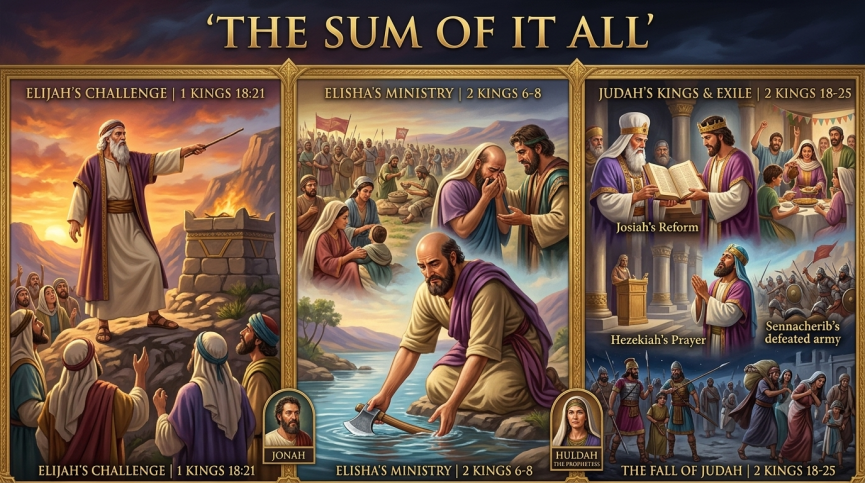
The Sum of It All
“Elijah then came near to all the people, and said, ‘How long will you go limping with two different opinions? If the LORD is God, follow him; but if Baal, then follow him’ ” (1 Kings 18:21).
Week 18, Day 1
2 KINGS 6–8
Perhaps the loveliest thing about the miracle stories clustered around Elisha is that they show God involved in all the issues of life, ranging from recovering a lost, borrowed ax head to extraordinary military triumphs. There are noble moments, as when Elisha delivers an army to Samaria. When the king asks, “Shall I kill them?” Elisha instead orders him to give them food and drink and let them return home. For a time, at least, it brought peace between the nations (6:20-23). There’s also nobility in the four lepers who stumble upon untold wealth in the deserted Aramean camp. At first they begin collecting loot, until they confess to one another, “What we are doing is wrong. This is a day of good news” (7:9). Good news and good fortune are to be shared, not hoarded.
Elisha’s servant, Gehazi, also behaves honorably in helping the Shunammite woman. Here the miracle comes through more conventional means: A king changes his mind as the result of what seems on the surface to be coincidental good timing.
We’re given a glimpse of the tender side of Elisha as he weeps at the prospect of what Hazael will do to the people of Israel after he becomes king. Hazael denies indignantly that he could ever be so base, but he returns home to inaugurate his new career with an act of just such shamelessness. Was he intentionally deceiving Elisha when he pleaded innocence of character, or didn’t he know his own depths?
PRAYER: My little world waits for small miracles of human thoughtfulness; make me your channel of favor, I pray; in Jesus’ name. Amen.
In some ways, Elisha is as irregular a personality as was his predecessor Elijah. What are the qualities that make him an effective prophet of God?
Week 18, Day 2
2 KINGS 9–11
Perhaps if you had your way, some of these stories of human brutality wouldn’t be in the Scriptures. But the Bible is utterly honest in its portrayal of us human beings. It doesn’t glorify our violence or intrigue, just as it never relates sexual misconduct in a way that is likely to titillate; but neither does it pretend that we are above such conduct, nor does it even apologize for it. It holds up the data and leaves it to us to draw conclusions on the basis of the ethical teachings found elsewhere in the Law, the Prophets, and the New Testament.
So Jehu, who “drives like a maniac” (9:20), becomes an instrument of judgment; and he fills the role with a passion. He sees himself as a reformer when he destroys Joram (9:22); and when he wipes out the family of Ahab, it is with the cry, “see my zeal for the LORD” (10:16); and in the same mood he massacres the followers of Baal (10:18-27). But physical destruction is always easier than inner renewal; “Jehu was not careful to follow the law of the LORD . . . with all his heart” (10:31). Nevertheless, perhaps he comes as close as any king of the northern tribes to being good, by the prophet’s judgment.
In Judah, a new day comes when Athaliah contrives to succeed her son Ahaziah following his death in battle. She tries to kill all the royal family to make the throne secure for herself; but an infant son of Ahaziah, Joash, is hidden for more than six years while Athaliah reigns. Then, led by the priest Jehoiada, seven-year-old Joash is made king.
PRAYER: In my sometimes violent world, let me make a difference. Amen.
These are bloody chapters! What lessons can be learned from them?
Week 18, Day 3
2 KINGS 12–14; PSALM 74
Joash (or Jehoash) is to be remembered for repairing the temple in Jerusalem. It is perhaps an even greater thing to restore what has fallen than to build anew, because particular patience and delicacy are required. After years of waiting for the priests to use accumulated gifts to begin repairs, Joash took things in his own hands and developed a special means of fund-raising. One occasionally finds a contemporary church with a “Joash Box” for anonymous offerings. Joash pleased the Lord through all his forty-year reign but died at the hand of servants.
His son Amaziah also pleased God; “he did what was right in the sight of the LORD, yet not like his ancestor David” (14:3). David, whatever the failures of his private life, continued to be the standard by which all his successors were measured. Amaziah had military ambitions, however, and they eventually led him into a disastrous war with Israel; he was not wise enough to take the advice of Israel’s king to “be content with your glory, and stay at home” (14:10).
Israel’s kings, meanwhile, continue in their sorry pattern. Jehoahaz, Jehoash, and Jeroboam II all suffer the same judgment: they follow the sins of Jeroboam son of Nebat (13:2, 11; 14:24). It is as if the writer sees them afflicted with a spiritual malady that passes on from generation to generation, almost as if they were seeking to imitate their regal ancestor. The prophet Elisha dies; but we hear of a new prophetic voice, Jonah (14:25). The word of the Lord goes on.
PRAYER: Help me see that you are never without a witness. Amen.
Both Elijah and Elisha ministered primarily to the ten northern tribes, Israel, and to their rulers. Yet not one king of Israel is described as being good, or as pleasing the Lord. Ponder the incongruity of such powerful witnesses, yet such limited results. What do you think?
Week 18, Day 4
2 KINGS 15–17
For some reason this writer says little about King Azariah (Uzziah), though he reigned fifty-two years. We will learn more of him in the Chronicles and also in the prophet Isaiah. Both he and Jotham are generally good, except for their allowing sacrifices at the high places, the unappointed altars in Judah. But Ahaz is another matter. He “walked in the way of the kings of Israel,” even to the point of taking on practices of the pagan nations around him (16:3-4).
But the main burden of these chapters is the fall of Israel. There is a dreary run of short reigns (Zechariah, Shallum, Pekahiah) and of empires set up on assassinations (Pekah, Hoshea). But mostly we sense doom in the air, not only in the instability of Israel’s throne but more ominously in the rising power of Assyria. Menahem buys time from King Pul of Assyria (15:19-20), but one knows this is only a stopgap measure.
During Pekah’s reign Assyria invades several areas, carrying off numbers of people; then disaster comes in the ninth year of Hoshea’s reign, when the land is overcome by the Assyrians, the mightiest war machine of their time. This invasion is dated at 722 B.C.; and for all practical purposes, it marks the end of the ten northern tribes. Their identity is slowly lost through intermarriage, so that today they are often popularly referred to as “the ten lost tribes of Israel.” And it happened “because the people of Israel had sinned against the LORD their God” (17:7) and stubbornly resisted the warnings of every prophet (17:13-14).
PRAYER: Make me sensitive in my time, O Lord, to your warnings. Amen.
Second Kings 17 reports the final fall of the Northern Kingdom, and tells us why. The explanation is not military or economic but spiritual. List and reflect on the reasons the writer gives for Israel’s fall.
Week 18, Day 5
2 KINGS 18–20
After coping with the intrigues, assassinations, and at last invasion in the closing days of Israel’s story, it’s good to think about King Hezekiah. The writer says simply that “there was no one like him among all the kings of Judah” (18:5) in his faithfulness to the Lord.
Not that the times were easy. When Israel was invaded, Hezekiah had to know that Judah was also at peril; and in time King Sennacherib of Assyria came. He engaged in a propaganda war to break the morale of the people, insisting on the one hand that no other gods had been able to stand against him (18:33-34) and on the other that the Lord had sent him to defeat Judah (18:25).
When Sennacherib sent a declaration of war, Hezekiah “went up to the house of the LORD and spread it before the LORD” (19:14) and prayed. He was then assured by the prophet Isaiah (a wonderful person to have on your side!) that God would defeat the Assyrians. Not only were they dramatically defeated; Sennacherib himself was killed by his sons while—of all things—he was in the house of his god Nisroch (19:37).
Some time later Hezekiah became ill and received word that he should set his house in order, because he was not going to recover. Again he prayed, turning his face to the wall, and Isaiah told him that God would add fifteen years to his life. In those years, unfortunately, he erred by showing his wealth to envoys from Babylon. Thus Babylon in time would do what Assyria could not—invade Judah.
PRAYER: Help me, O Lord, to use answered prayers only to good. Amen.
Hezekiah was one of Judah’s best kings. How do you assess his strengths and his weaknesses?
Week 18, Day 6
2 KINGS 21–23; PSALM 75
Manasseh, Hezekiah’s son, tipped the scales to evil as far as his father had tipped them for good. It is as if he set out to counter all the good his father had done. He led the people into “the abominable practices of the nations that the LORD drove out before the people of Israel” (21:2), until at last he “misled them to do more evil” than those nations (21:9). It was a long reign, fifty-five years; and then his son, Amon, followed the same course for two years, walking “in all the ways in which his father walked” (21:21).
Amon was killed by his servants and was succeeded by his eight-year-old son, Josiah, who eventually became a king “who turned to the LORD with all his heart, with all his soul, and with all his might” (23:25). During his reign the high priest Hilkiah stumbled upon the book of the Law in the house of the Lord (22:8). It was probably the Book of Deuteronomy; one wonders how a document of such value was ever mislaid. But, of course, almost anything could have happened in the fifty-seven years of Manasseh and Amon.
The prophetess Huldah urged a penitent return to God’s Law, and Josiah led the way. He instituted a massive cleansing of the religious practices of the country and then a celebration of the Passover, which no one had kept “since the days of the judges” (23:22). He died in battle, but only after leading his nation back to God.
PRAYER: Grant your mercy this day on those for whom your word is as much hidden as when it was lost in days long ago; in Christ. Amen.
If I were to say that Josiah was to Judah what Martin Luther was to Christendom, what evidence would you find for my statement?
Week 18, Day 7
2 KINGS 24–25; PSALM 76
And now another curtain is about to fall. It will come down somewhat fitfully, but in the end we will see Judah fall into captivity just as we saw with Israel more than a century before. The decline begins with the three-month reign of Jehoahaz, then eleven years under Jehoiakim during which the Babylonians, under King Nebuchadnezzar, make their first invasion. At first Jehoiakim pledges servitude, but in time he rebels. At his death his son Jehoiachin takes over, but only for three months before he has to surrender to Babylon. This time Babylon carries away not only the accumulated treasures of the centuries but also “the men of valor,” officials and warriors, artisans and smiths, leaving behind only “the poorest people of the land” (24:14-16). The king of Babylon made Zedekiah, Jehoiachin’s uncle, the puppet king over what remained in Judah (24:17-18).
In time Zedekiah foolishly tried to rebel. The remnant still in Jerusalem suffered greatly under a Babylonian siege, and Zedekiah himself was mercilessly blinded. Years later Jehoiachin was released by a benevolent Babylonian king so that he could dine for the rest of his life in the king’s presence (25:27-30), but Judah was now a captive people.
The writers of Second Kings are consistent. They believed in the justice of God, that sin brings inevitable tragedy, whether it be the sin of individuals or of rulers; and it never occurred to them to think that Judah and Israel, though God’s chosen people, should be exempt.
PRAYER: Thank you, Father, for a universe in which there is a moral order. Help me to trust you in the working of that order; in Christ. Amen.
Why did the Babylonians loot, especially, the temple? Or is it just that the historian emphasizes that activity?
Prayer Time
I will pray daily for these public officers and public commentators who should be remembered in prayer:
How the Drama Develops 2 KINGS 6–25
During the course of these chapters, our drama takes a decidedly sorry turn—a turn from which it never fully recovers. Fortunately, however, the eventual purposes of this drama do not depend solely upon the conduct of the human actors. God is always involved, and one of God’s major activities, it seems, is to take the confused stuff of human sin and error and weave it into the achieving of the divine purposes.
The burden of these chapters is the decline and fall of the two kingdoms. The northern tribes go first. This doesn’t surprise us—at least not from the point of view presented by the biblical historian, because he or she believes the secret of Israel’s strength is in their loyalty to the purposes of God. And as for the northern tribes, their loyalty is long lost. Even the dramatic, heroic efforts of Elijah and Elisha are not enough to stem the tide of apostasy, particularly since no king ever takes a stand for righteousness. The pattern was established at the outset by Jeroboam, who reasoned he could hold his empire together only if he had the people’s spiritual commitment. And he was sure that wouldn’t be possible if the people returned to the capital of the Southern Kingdom, Jerusalem, for their holy days. So he began to establish another pattern and setting of worship. It was a political decision, logical in its own right, but morally wrong. The northern tribes never recovered. They simply went farther and farther away from God, until at last they were invaded by the Assyrians. The Northern Kingdom essentially disappears. Since they didn’t have enough spiritual integrity to hold them together in their homeland, of course, there wasn’t enough to sustain them in a land of exile where it was expedient to embrace other gods. So the northern tribes simply ceased to exist. From this time forward, when we speak of Israel, we are speaking almost entirely of the two tribes (and Levi) that constituted Judah.
Why did Judah survive when Israel did not? Were their prophets better than Elijah and Elisha? I think not. I think the issue is in their rulers. Now and again Judah got good leadership. Not perfect; that isn’t to be expected in our imperfect world. But numbers of reasonably good, reasonably devout people, and several highly admirable ones.
This world belongs to God. . . . We need to remember this when the power of evil is so insistent that we think we are helpless before its assault.
—From Parables From the Back Side (1992); page 48
Some, like Joash (Jehoash) and Josiah, led the way in spiritual renewal. Joash was blessed by the influence and counsel of the priest Jehoiada, but in time it was he who prodded the priesthood. As the years went by and nothing was done to repair the house of the Lord, Joash instructed the priests that they must “not accept any more money from your donors but hand it over for the repair of the house” (2 Kings 12:7).
It was during a temple housecleaning in Josiah’s time that the high priest Hilkiah discovered a book of the Law (generally considered to have been Deuteronomy) and got it to the king. Josiah used the occasion as a call to national reform. It was a noble movement. It was not enough to fully stem the tide of Judah’s eventual decline, but it did postpone it.
Did it, perhaps, play a part in holding Judah to the truth, so that in her exile she did not disintegrate, as did the northern tribes? Was this the difference, along with the ministry of Jeremiah and Ezekiel? I wouldn’t rule out the possibility.
Seeing Life Through Scripture
In his classical study of the Roman Empire, the eighteenth-century British historian Edward Gibbon attributed part of the fall of Rome to its moral and spiritual decline. The writer of Second Kings would concur with such an interpretation of a nation’s decline. There was no doubt in his mind as to why Israel was defeated by Assyria: “This occurred because the people of Israel had sinned against the LORD their God. . . . They had worshiped other gods and walked in the customs of the nations whom the LORD drove out before the people of Israel. . . . The people of Israel secretly did things that were not right against the LORD their God” (2 Kings 17:7-9).
Only a rare public commentator would dare to suggest, in our day, that the decline of a nation is related to its spiritual condition. Come to think of it, even professional theologians and clergy are cautious about doing so. I’m not suggesting we should be casual in relating God to historical developments. And yet, are some events of history still touched by the hand of God? And is it still true there is a moral quality in our universe, so that a nation that ignores such morality will suffer? Or has God abdicated history? Is everything in history simply a product of natural, political, and economic forces? What would the writer of Second Kings say to our times, I wonder?
Kalas, E. J. (2016). The Grand Sweep: 365 Days From Genesis Through Revelation. Abingdon Press.