
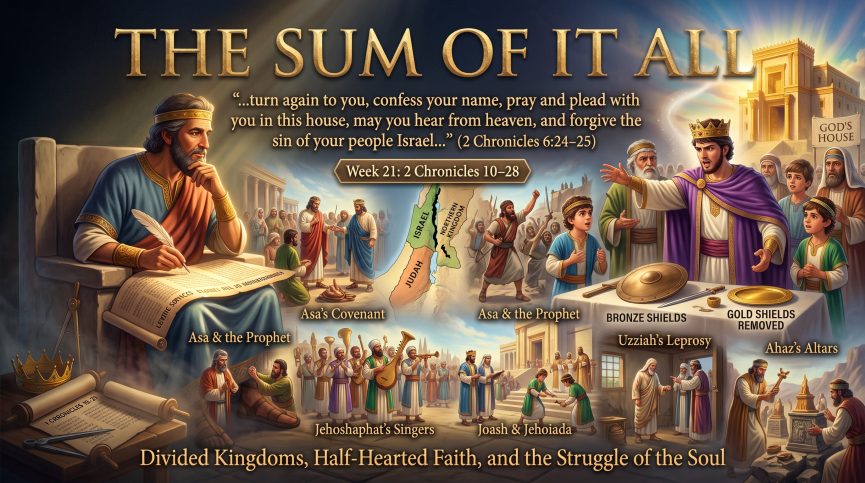
The Sum of It All
“When your people Israel, having sinned against you, are defeated before an enemy but turn again to you, confess your name, pray and plead with you in this house, may you hear from heaven, and forgive the sin of your people Israel, and bring them again to the land that you gave to them and to their ancestors” (2 Chronicles 6:24-25).
Week 21, Day 1
2 CHRONICLES 10–12
I think it would be difficult to grow up as the son or daughter of a king and retain one’s personal equilibrium. That may give us a bit more sympathy with Rehoboam as we see him deal so poorly with Jeroboam and his delegation. Rehoboam was accustomed to the feeling of power, and he liked it; so when his young counselors urged him to throw his weight around, he did it—and he lost the northern tribes.
He began to rebuild his power. He was encouraged by the loyalty of the Levites and perhaps especially by the fact that some of the more devout among the northern tribes came to Judah in order to be able more surely to fulfill their religious vows (11:13-16). But then it appears that Rehoboam’s pride reasserted itself, for “when the rule of Rehoboam was established and he grew strong, he abandoned the law of the LORD” (12:1). Defeat at the hands of Egypt brought him back, especially as the prophet Shemaiah told Rehoboam and his advisors that God was displeased with their conduct. So they humbled themselves before God (12:6) and escaped a measure of loss.
There’s something pathetic in the faded grandeur described in 12:9-12. When the king of Egypt carried away the shields of gold, Rehoboam replaced them with shields of bronze; but still they made a kind of grand processional each day, as if the glory had not really departed. Perhaps they were making the best of a bad scene.
PRAYER: When I repent, dear Lord, and experience your mercy, give me the character to live up to my words of regret; in Jesus’ name. Amen.
What does Rehoboam’s handling of the challenge from Jeroboam tell you about Rehoboam the man?
Week 21, Day 2
2 CHRONICLES 13–15
We know from our earlier reading that Asa was a king who “did what was good and right in the sight of the LORD,” but the Chronicler gives us two insights into the quality of his faith. After enjoying peace for ten years, Asa found himself facing the massive military strength of Zerah the Ethiopian. It seemed quite clear Asa could never win, but he made his case before God. “O LORD, there is no difference for you between helping the mighty and the weak” (14:11). It was the kind of faith young Jonathan expressed generations earlier (1 Samuel 14:6) when he reasoned that God can save by many or by few. Someone has said that “one with God is a majority.” Asa seemed to believe that.
After Asa won so handily against the Ethiopians, his soul may well have been in danger. Success is a dangerous potion. In any event the prophet Azariah came to Asa with a message that had in it both assurance and warning, and with it an urging to “take courage.” Asa did just that. He “put away the abominable idols,” which were still everywhere in the land, and then “he repaired the altar of the LORD that was in front of the vestibule of the house of the LORD” (15:8).
A number of action verbs follow: They sacrificed to the Lord (15:11), they entered into a covenant (15:12), and they took an oath (15:14). Nothing passive about this commitment! In fact Asa went so far as to remove his mother from office because of her idolatry (15:16).
PRAYER: Give me a faith in you, O Lord, which shows itself in solid commitments and faithful actions; in Jesus’ name. Amen.
What specific reforms did Asa institute?
Week 21, Day 3
2 CHRONICLES 16–18; PSALM 85
Asa was a good man and a good king, but like anyone who has grown accustomed to power, he didn’t like to be crossed. That meant trouble, because there were prophets in Judah and Israel; and it was the business of prophets to cross people, including kings, if they violated the will of the Lord. When Asa made an alliance with Benhadad of Aram without seeking counsel from the Lord, the seer Hanani told him he had done wrong; he ought to have trusted in the Lord God who empowered him to fight the Ethiopians. Instead of repenting, as his ancestor David did when the prophet Nathan came to him, Asa threw the prophet in prison, and in his rage even inflicted cruelties on some of his people (16:10). Still worse, Asa didn’t seek God even when personal distress came his way. It’s a sorry end to what had been a very good life (16:12).
The prophet Micaiah ran into the same kind of resistance in witnessing to King Ahab of Israel. “I hate him,” Ahab said, “for he never prophesies anything favorable about me” (18:7). Apparently it never occurred to Ahab to change his ways in order to get a favorable message; instead, he just became angry with the messenger. Micaiah’s position was especially difficult because there were prophets available who were ready to give whatever report the king wanted. It wasn’t easy to be a prophet in Judah or Israel, even though these nations presumably were God’s covenant people. Sometimes, you see, they found the covenant troublesome.
PRAYER: When I receive a message that upsets me, help me to seek you penitently rather than resenting the messenger; in Christ. Amen.
How do you explain the change in Asa’s character in 2 Chronicles 16?
Week 21, Day 4
2 CHRONICLES 19–21
What do you do with bad news? When Jehoshaphat was told that the armies of Edom were marching against his people, “he set himself to seek the LORD, and proclaimed a fast” (20:3). Then in the assembly of the people he reasoned with God, reminding God of the way Jehoshaphat’s ancestors had dealt with Edom. He confessed that he and his people were “powerless against this great multitude. . . . We do not know what to do, but our eyes are on you” (20:12).
His answer came through Jahaziel, a Levite, as the spirit of God came upon him. It was a message of good cheer: “Do not fear or be dismayed at this great multitude; for the battle is not yours but God’s” (20:15). In this case a Levite acted as a prophet. Usually the priests and Levites filled more of a structured, institutional role, while the prophets acted in apparently irregular, spontaneous fashion; but occasionally Levites also acted as prophets, as in this case.
The battle that followed was extraordinary. A company of singers, “in holy splendor,” preceded the army, singing their traditional hymn of faith:
“Give thanks to the LORD,
for his steadfast love endures forever” (20:21).
We’re not surprised that they returned to Jerusalem with joy, victorious. We’re only sorry that twice (19:1-3; 20:35-37) Jehoshaphat missed God’s leading, and that his son Jehoram followed the wrong examples.
PRAYER: In times of conflict, help me to lean on you, O Lord. Amen.
How do you explain Jehoshaphat’s reign being “right in the sight of the LORD” when so many elements were still wrong (2 Chronicles 20:31-33)?
Week 21, Day 5
2 CHRONICLES 22–24
Judah experienced evil days not only under Jehoram but also during the long reign of Ahaziah and then in the bloody coup of Queen Athaliah. But some good people were at work behind the scenes, especially Jehoshabeath, who endangered her own life to save the baby Joash, then protected him for nearly seven years until her husband, Jehoiada the priest, was able to place Joash on the throne.
He was only a boy at the time, but under the influence of Jehoiada he did all the right things. Most notably, he led the way both spiritually and administratively in the restoration of the temple.
But apparently he was not a very strong person. When Jehoiada died, Joash came under the influence of advisors who caused him to abandon the house of God, the very place he had worked so hard to repair, and to raise up places of idol worship. When Jehoiada’s son, Zechariah (Luke 11:51), stood to challenge his evil, Joash “did not remember the kindness that Jehoiada . . . had shown him” (24:22) and killed Zechariah.
It isn’t our business to pass judgment on Joash or anyone else, but to the degree that we can learn from their lives, we should. It appears that Joash, who was influenced for good by Jehoiada, was just as easily influenced toward evil once Jehoiada was gone. Perhaps Joash never fully got a faith of his own, or getting it, neglected it under the pressures and expediencies of office. In any event, it’s a sad ending.
PRAYER: Help me, dear Savior, to run the race with faithfulness to the very end, never stopping until I am finally with you; in Christ. Amen.
Interpret the personality and character of King Joash with and without the influence of Jehoiada the priest.
Week 21, Day 6
2 CHRONICLES 25–26; PSALMS 86–87
Amaziah was a good king but not really good enough. As the New International Version puts it, “He did what was right in the eyes of the LORD, but not wholeheartedly” (25:2). That doesn’t suffice for a faith that commands, “You shall love the LORD your God with all your heart, and with all your soul, and with all your might” (Deuteronomy 6:5). We’re not surprised, then, when Amaziah brings back the gods of the people of Seir after he has defeated them, and worships these gods. A prophet asks him, quite logically, “Why have you resorted to a people’s gods who could not deliver their own people from your hand?” (25:15); but we’re inclined to do illogical things when we follow God with only half a heart. I think Amaziah recognized the truth of the prophet’s logic, for it angered him to the point that he threatened the prophet’s life (25:16).
Uzziah, on the other hand, was good but not long enough. He came to the throne as a sixteen-year-old; and he did what was right in the sight of the Lord, aided by the instruction of Zechariah, “who instructed him in the fear of God” (26:5). But as we have noted before in the stories of the kings (and in experiences closer to home, too), power is a peril. “When he had become strong he grew proud, to his destruction” (26:16). He usurped the office of the priests and was smitten with some form of leprosy. Because of the Hebrew laws of isolation for lepers, he remained in a separate house from then until the day of his death.
PRAYER: Give me a love for you, dear Lord, which is both deep and long, so that I will follow you all the days of my life; in Christ. Amen.
As you read the story of Uzziah, Zechariah, and Azariah, what sense do you have of potential power jealousies between king and priest?
Week 21, Day 7
2 CHRONICLES 27–28; PSALM 88
Sometimes we learn from the bad examples of others. Perhaps that was the case with Jotham, son of Uzziah. The Chronicler says that he did what was right in the sight of the Lord just as his father Uzziah had done, except that “he did not invade the temple of the LORD” (27:2). He repaired the temple and built cities and forts, and won battles, too; he “became strong because he ordered his ways before the LORD his God” (27:6).
But if Jotham learned from his father’s mistakes, his son Ahaz did not learn from Jotham’s admirable example. It is not that Ahaz was indifferent to God; he was outright hostile, following the example of the kings of the northern tribes rather than the sometime goodness of his own predecessors in Judah. It seems almost as if he went in search of evil practices, making images for Baal, making his sons pass through fire in the manner of the pagan peoples, and offering sacrifices “under every green tree” (28:4).
At last he came to a time of distress. Trouble drives many people to God and to a re-evaluation of their way of life, but not Ahaz. He simply “became yet more faithless to the LORD” (28:22), finding new gods among the people of Aram, making altars to false gods “in every corner of Jerusalem” (28:24). His life ended in such shame that the people chose not to bury him among his fellow kings.
PRAYER: As I compare the stories of those who followed you and those who denied you, I am more than ever persuaded to give you my all. Amen.
How do you explain the evil reign of Ahaz, following the righteous reign of his father Jotham?
Prayer Time
Nations and governments always need our prayers, but usually we’re inclined to pray too generally; here are specific persons and issues for which I will pray daily:
How the Drama Develops 2 CHRONICLES 10–28
The writer of Chronicles obviously wants to concentrate on the story of Judah. Where the writer of Kings moves back and forth between the two nations—Israel and Judah—Chronicles mentions Israel in these chapters only at the point of their break with Judah, and at those times when their history directly intersected Judah’s. At the time of the revolt the writer says, “So Israel has been in rebellion against the house of David to this day” (2 Chronicles 10:19). The Chronicler sees the plot line developing through Judah; and when Israel breaks from “the house of David,” the Northern Kingdom ceases to be of real interest to him.
But even Judah’s story is one of a nation on a slippery slide. After Rehoboam’s ill-fated handling of the Jeroboam matter, he seeks the Lord for a time; and it appears his kingdom will be on solid footing, because the priests and the Levites come with him (11:13-17). But when his rule was established, “he abandoned the law of the LORD,” and the nation with him (12:1). He returned to God at times, but the summary of his reign was, “He did evil, for he did not set his heart to seek the LORD” (12:14).
Perhaps that summarizes what will follow. Judah has many quite good kings in succeeding periods; some even border on greatness. But in so many cases the judgment would have to be “good, but not good enough.” Asa, for example, made admirable commitments to righteousness as he cleared “the abominable idols” from the land and repaired the altar of the Lord (15:8). His heart “was true all his days” (15:17). And yet, when his nation was being attacked by King Baasha of Israel, he turned to the king of Aram for help rather than relying on the Lord. Somehow his goodness, fine as it was, was not inspirited by the kind of faith that would sustain him in a crisis.
Jehoshaphat too was admirable in so many ways, “doing what was right in the sight of the LORD” (20:32). But he allied himself at times with the wicked King Ahab, and then with the equally wicked Ahaziah; so it isn’t surprising that his son Jehoram married a daughter of Ahab and entered an eight-year reign in which he is described as being like the kings of Israel, wicked in the sight of the Lord.
One hopes the nation is on the way back in the reign of Joash, and again with Uzziah. Joash is especially notable in his repairing of the temple. But we discover that his goodness depends largely on the influence of the priest Jehoiada. When Jehoiada is gone, Joash forsakes the Lord; he even executes Jehoiada’s courageous son Zechariah. Uzziah had one of the longest reigns of any king of Judah, fifty-two years, and he did well “as long as he sought the LORD” (26:5). But power was apparently more than his character could handle, and in time he tried to usurp the power of the priesthood along with the power of the throne, so that he ended his reign in shame and isolation.
We humans bear the burden of questions and struggles of the soul. And it is that burden that fills the soul with awe and eternity.
—From All Creation Sings: The Voice of
God in Nature (2010); page 44
Perhaps the best, simple summary of these passing generations is in the word that described Amaziah, another basically good king: “He did what was right in the sight of the LORD, yet not with a true heart” (25:2). The commandment is that we shall love the Lord our God with all our being. When we try to settle for less, following half-heartedly or with tactful reservations, our souls are eventually in danger. And the peoples and causes with which we are associated come in danger too.
Seeing Life Through Scripture
Separation of church and state is a key issue in our times. I think it is a difficult issue to interpret impartially, because, of course, we are always somewhat captive to the mood of our times.
Almost everything we read presents organized religion as if it were always trying to take over government; and I’ll readily admit such a hazard exists, because no one is exempt from the temptations of power.
But the story in Second Chronicles reminds us there is another danger too—that government will try to control religion. The basic peril is the same: Power demands still more power, because power is rarely satisfied with its fair share. The kings of Judah enjoyed the benefits that came to them through priests and prophets, but they also became jealous when they thought their control was being challenged.
Where are the correct boundaries in our day? The situations are not directly comparable, of course, because Judah liked to consider itself a theocracy, a nation ruled by God. Yet the issues are basically the same. Religion and government are both powerful entities even though they operate in adjacent rather than identical realms, and they will always live in uneasy coexistence. Both are needed, but how and where do we draw their respective lines?
Kalas, E. J. (2016). The Grand Sweep: 365 Days From Genesis Through Revelation. Abingdon Press.