
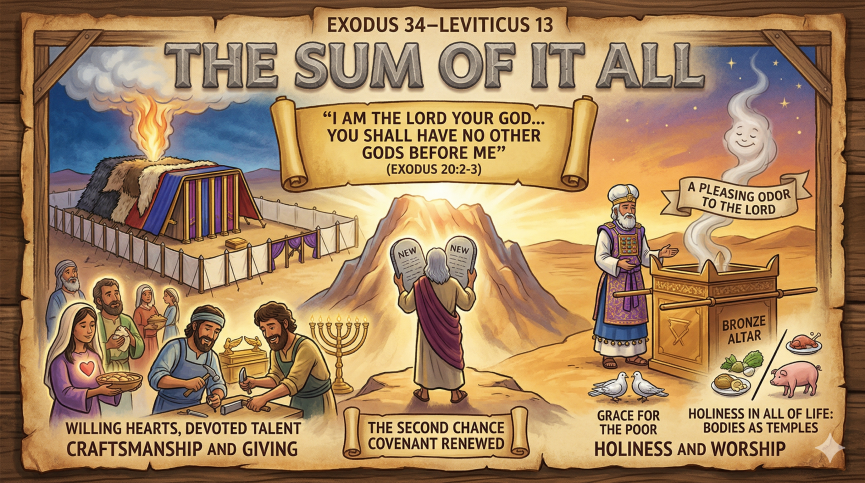
The Sum of It All
“I am the LORD your God, who brought you out of the land of Egypt, out of the house of slavery; you shall have no other gods before me” (Exodus 20:2-3).
Week 6, Day 1
EXODUS 34–36
Exodus 34 is a chapter of the second chance. Moses is privileged to return to the mountain to receive a new set of the tables of the Law, to replace those that were broken.
Moses confesses that his people are “stiff-necked” but asks that God “take us for your inheritance” (34:9). The covenant is renewed, with a solemn warning about the perils that lie ahead. Israel will have the power to conquer the nations they will one day face, but they must guard against taking on the evil practices of those people.
It’s interesting to see what matters are emphasized here. Idols—a reminder that their recent disaster came at this issue. And remember the festival of unleavened bread (34:18); this will remind them of their deliverance from slavery. Remember, too, the obligation of the firstborn; a reminder of the climaxing plague. And the sabbath (34:21-24), because this is the unique symbol of God’s people. Moses came from this encounter with God with a face that shone too brilliantly to be viewed.
Then there is the story of talent and of willingness. What a beautiful combination! Neither is fully adequate without the other. The two craftsmen, Bezalel and Oholiab, were joined by “everyone whose heart was stirred to come to do the work” (36:2). A freewill offering was received, with response so great that “the people were restrained from bringing” more (36:6). What a happy quality of commitment!
PRAYER: I want my heart to be so devoted to you that I can hardly contain my desire to give; to your glory. Amen.
Ponder the second giving of the Law and the renewed promise that came with it, and compare the “second chances” God has brought to your life.
Week 6, Day 2
EXODUS 37–40
A great entertainer once said that he became an overnight success after twenty years of hard work. Most of life’s best achievements are the product of tedium. It may be devoted and even inspired tedium, as in the case of Bezalel and Oholiab, and it will almost surely be crowned from time to time with feelings of achievement. And yes, for one who loves what he or she is doing, even the tedium has a kind of glory. Nevertheless, routine and discipline are inevitable factors in any true accomplishment.
That’s something of the lesson of these chapters. Step by step the workers produced the tabernacle, its furnishings, and the garments of the servers. When they were finished it could be said that they “had done all of the work just as the LORD had commanded Moses” (39:42). Now Moses could anoint and consecrate each item, and he, too, “did everything just as the LORD had commanded him” (40:16).
Then God placed a special seal of approval upon the project. The cloud that symbolized God’s presence “covered the tent of meeting, and the glory of the LORD filled the tabernacle” (40:34). The glory was so great that, for a time, not even Moses could enter the building. Let this be a word to all who prepare and teach Sunday school lessons, all who earnestly serve on committees, all who write sermons and sing in church choirs: Do so with dedication and God will visit with glory.
PRAYER: I ask not for a glory that I cannot endure, but for that which will draw me nearer to yourself; in Jesus’ name. Amen.
List as many as possible of the products that went into the Tabernacle.
Week 6, Day 3
LEVITICUS 1–3
The tribe of Levi became the spiritual leaders of the nation. As such, they lost their tribal identity; their place among the twelve was now taken by the dividing of Joseph’s descendants into the tribes of Ephraim and Manasseh. The Levites were to find their portion in the Lord rather than in a unit of land.
This book is largely a guide for the Levites in their work, but as such it mattered to all of Israel—perhaps in the same way the Constitution of the United States matters to all its citizens, even though it is the particular responsibility of the courts.
This is especially true for those of us who believe in the Protestant doctrine of the priesthood of all believers. Not that we are instructed by the details of conduct at the altar of sacrifice or proper methods of preparing animals for burning, but by the spirit and commitment with which the Levites were expected to do their work.
A grain offering, for instance, was to “be of choice flour”; and if one brought an animal before the Lord, it should be “one without blemish” (2:1; 3:1). God is to receive the first fruits (2:14), not the leftovers and not what is not good enough for the commercial market. If I sing, I will give my best at the church, preparing as earnestly as if it were for a secular concert; whatever I do, it shall be an offering that will be a “pleasing odor to the LORD” (1:9).
PRAYER: Let me be your priest, O Lord, offering my life and my daily duties as my sacrifice of love to you; in your name I pray.
So many intricate details go into the Levitical order of worship. What significance does this hold for you in your own life of prayer and worship?
Week 6, Day 4
LEVITICUS 4–6
The blood sacrifices of ancient Israel are usually offensive to our modern sensitivities. But they help us understand the seriousness of sin. Dietrich Bonhoeffer warned against “cheap grace”; all of us are susceptible to such a disposition, especially in a time when society seems to suggest that “anything goes.” Leviticus makes clear, by its system of sacrifices, that sin is an affront to God. This, even beyond what our misdeeds do to others and to our own bodies and psyches, is why we must treat sin seriously. Yes, Leviticus has something to teach us.
A lovely provision is made for those who are poor. “If you cannot afford a sheep, you shall bring to the LORD . . . two turtledoves or two pigeons” (5:7); and “if you cannot afford two turtledoves or two pigeons, you shall bring . . . one-tenth of an ephah of choice flour” (5:11). But while provision is made for economic limitations, everyone is expected to bring something. No one is exempt from the recognition of sin or from dealing with it.
What is our responsibility to the persons we may have harmed? When Israelites defrauded or deceived a neighbor, the Law required that they “repay the principal amount and . . . add one-fifth to it” (6:5); but then the guilty party must also bring to the priest a guilt offering to clear the soul before God. Our sins have both a horizontal and a vertical dimension; we deal with them before God and whatever injured party.
PRAYER: I am sometimes casual about the wrong I have done; thank you for reminding me of my blood-guilt; and save me, through your Son. Amen.
Why is it necessary to deal with sins that were committed “unintentionally”? In what sense is something a sin if it wasn’t intentional?
Week 6, Day 5
LEVITICUS 7–9
Israel was called to be a holy people—that is, a people separated to God and to God’s purposes. But if there is to be a holy people, a particular burden rests upon those who are called to lead to holiness. Thus the ceremony is long and complex, with details that may easily seem tedious to us.
But the end of the matter is cleansing. Those who would serve God must be God’s clean people, and the physical and ritual events merely emphasize the issue of spiritual purity. “It will take seven days to ordain you,” Moses warns (8:33). The Scriptures often use numbers in a symbolic way, to make some significant point. Seven is the number of completeness or perfection, so the seven-day ceremony conveys the idea of a completed act of dedication and a finished holiness.
The consummation of it all is found in 9:22-24, in the blessing of the people. When Moses and Aaron come out of the tent of meeting (the tabernacle) to bless the people, “the glory of the LORD” appears. The writer of Leviticus recalls it as such an awesome sight that the people shout and fall on their faces.
We shout at sporting events, and applaud and sometimes even call “bravo” at an opera or a concert, but we do not often feel such excitement at the presence of God, and even less often do we show it. It may be, again, that Leviticus has something to say to us.
PRAYER: When I serve, O Lord, let it be with purity of heart; and when I worship, let it be with holy excitement; in Jesus’ name. Amen.
References are made several times to an “elevation offering.” Do we have anything in contemporary public worship that is comparable?
Week 6, Day 6
LEVITICUS 10–11; PSALMS 33–34
The teaching of Chapters 8 and 9 is dramatically demonstrated in this story of Nadab and Abihu. As Aaron’s sons, they were in the highest ranks of the priesthood, yet somehow the awesome responsibility hadn’t fully gotten to them.
They violated their office by offering “unholy fire,” and they died. Aaron, who it seems had himself erred far more seriously in the making of the golden calf, “was silent,” and Moses instructed Aaron and his sons Eleazar and Ithamar not to mourn.
Nadab and Abihu’s misconduct apparently sprang from their being intoxicated (10:8-11). If it is hazardous to drive a high-powered engine after drinking, how much more, Aaron’s sons proved, to deal with holy things with less than our best ability.
The subject of clean and unclean foods may seem mundane after the Nadab and Abihu story, but for the writer of Leviticus they are all of a piece. Holiness is an issue not only while ministering in the tabernacle but in all of life. The rules were pragmatic. Maintaining health and sanitation in a desert world, among essentially nomadic peoples, was not simple. Every precaution had to be taken. Many foods that can be safely prepared in our time were a hazard in that time and setting.
The spiritual issue of dietary regulations became an issue early in the Christian church, especially as non-Jews came into the fellowship. The discussion arises often in the Book of Acts.
PRAYER: Help me, I pray, to treat all of life with a sense of awe, lest I thoughtlessly handle holy things in a common way. Amen.
Why were Aaron and his other sons not to mourn the death of Nadab and Abihu? (See also Leviticus 21:10-12.)
Week 6, Day 7
LEVITICUS 12–13; PSALM 35
Religion at its best involves all of life: a healthy spirit fed by a healthy mind dwelling in a healthy body. The New Testament tells us that our bodies are the temple of the Holy Spirit (1 Corinthians 6:19). The laws of Leviticus teach us the same thing in another way by their often intricate rules for care of the body and for sanitation. These rules tell us, tacitly yet forcefully, that our bodies are holy.
In the ancient world the term leprosy covered a wide range of diseases, from simple and curable to the most fearful. Many of these skin diseases were infectious, so extreme precautions were taken. These Jewish sanitary rules were far in advance of the rest of the world. Some western medical practices didn’t catch up with them until the middle of the last century.
We are coming increasingly to understand that a profound tie exists between the health of the soul and the health of the body. It is significant that the tribe of Levi was responsible for both. They led the nation in worship and they watched over its health. “Glorify God in your body,” Paul said (1 Corinthians 6:20). Other things being equal, our bodies have their best chance for health when our spiritual lives are healthy. The Sunday morning jogger would do better to join in the adoration of God, and the worshiper should celebrate divine adoration with a body that has been treated with holy respect.
PRAYER: Help me, Lord, to treat my body as your temple, so that it may be blessed with your fullness of health; in Jesus’ name. Amen.
What connection do you find, in these chapters, between ritual and sanitary cleansing and inner personal purity?
Prayer Time
I will pray daily for the following professional church workers:
I will examine my heart about these aspects of my worship and service:
How the Drama Develops EXODUS 34—LEVITICUS 13
We might easily conclude that the development of the eternal drama is put on hold during the chapters currently under consideration. I’ll readily admit there is little physical action, little of the kind of movement that seems necessary to the unfolding of a plot. But action is only chaos unless there is also structure, and that’s where life’s rituals and laws come in. In these chapters, the action begins with a second chance. When we Christians think of the Law, we usually think of a rigid, unforgiving system. But the Exodus story tells us that before the Law ever had a chance to be implemented, it was violated, and that mercy had to intercede so the Law could be renewed and given again. The grace that culminates in Jesus Christ and the cross is foreshadowed in Exodus 34 when Moses cuts two tablets “like the former ones,” and God writes again.
How can a drama have any hope unless there is a second chance?
And then there is beauty, as symbolized by Bezalel and Oholiab and “everyone whose heart was stirred to come to do the work” (36:2). When I read the detailed listing of materials, measurements, and plans, I think of craftspeople I have seen at work—the kind of people who run their hands gently over a piece of wood to feel its texture in the soul, or the person who holds needlepoint at a distance and frowns, then smiles. The craftspeople who brought together that portable Tabernacle were sure they were involved in an eternal enterprise; they were constructing a place in which the Lord God would appear and where the people would meet the Eternal.
Of course, we find it hard to give attention to the intricate details regarding the sin offerings, the guilt offerings, the patterns of restitution, and the lengthy details of ordination. But perhaps we have hurried at the wrong places. Could it be that if we spent more time with sin and guilt offerings, we would spend less time on the psychiatrist’s couch? Did the ancient Israelites know something to which we ought to pay more attention when they took sin and guilt so seriously? Some issues of life simply won’t allow themselves to be hurried over; if we scurry on, ignoring them, they simply go undercover and attack us in our dreams or in uninvited thoughts. Israel had rituals for coping with sin and guilt; and at their best, they understood that those rituals were acted out before the God of the universe. It was this realization that brought true relief.
Ours is an age that easily confuses activity with achievement. The intricate, repetitive details of these chapters in Exodus and Leviticus require us to slow down, think, and be sure we do everything right. This is essential to the drama. A drama, after all, is more than action; it is scenery and setting, timing and costumes. Change the costuming in Shakespeare from seventeenth century to twenty-first century, and you give a very different flavor to the lines. And so it is with the rituals of our lives and the orderliness with which we receive them. When we read the insistent descriptions in these chapters, we are being prepared for the setting in which the action will take place. Without them, the action would be of a very different nature. All of this is part of who we are and how we relate to God.
Seeing Life Through Scripture
“Without blemish” is a phrase that appears often in the chapters of Leviticus that give us rules of worship. The people might be tempted to save the best of their flocks and herds for food or for marketing and give God the leftovers. No doubt! We are tempted as they were. When everything else is paid, we give God what (if anything) is left. We hurry to a church meeting with little preparation; we wouldn’t think of going so ill-prepared to a meeting for our business or profession. The church youth choir performs poorly; they admit their middle school or high school choir wouldn’t allow such shoddy work. We give God blemished offerings.
Another phrase that appears often is one that refers to certain offerings as having a “pleasing odor to the LORD.” A critic might think this language is too anthropomorphic, portraying God as human. I think, rather, that the term puts God within our reach in a delightful way. It lifts my offering out of the tithe or line item on a tax form and lets me feel that God finds pleasure in my expressions of love. God is not austerely removed from me but so close as to smile when I place my envelope in the offering plate or when I labor to get my part right in the choir anthem. The Book of Leviticus tells us, in childlike yet profound ways, that God is blessed by our love.