
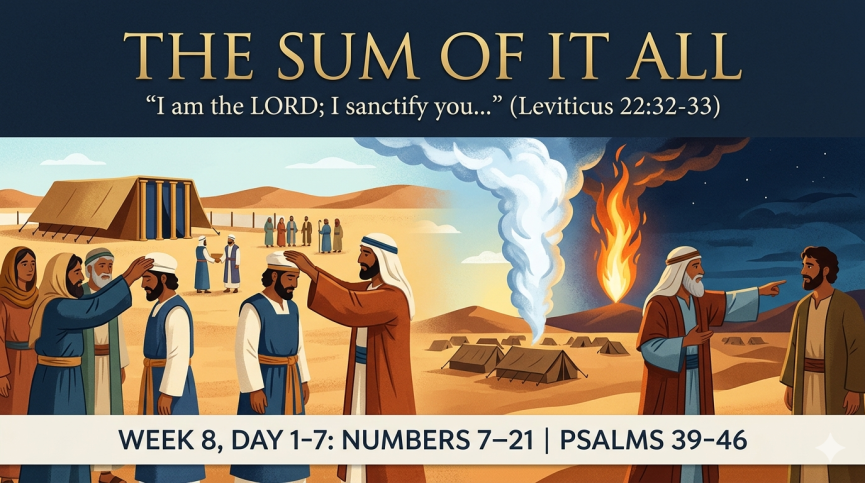
The Sum of It All
“I am the LORD; I sanctify you, I who brought you out of the land of Egypt to be your God: I am the LORD” (Leviticus 22:32-33).
Week 8, Day 1
NUMBERS 7–8; PSALM 39
Most of us would confess, after reading Chapter 7, that we would have been content if the writer had settled for the summary at the end rather than giving us the detailed, identical lists, which take up 72 verses. Rabbinical commentators felt that repetition was intended to show the stately solemnity that marked these gifts, and also to indicate that none of the princes wanted to outrank the others but that by their identical gifts they would show unity and harmony of spirit. According to tradition, Nahshon was chosen to lead the way because when the Israelites were pursued by the Egyptians at the Red Sea, the tribes hesitated to enter the waters; and while each urged the other, Nahshon plunged in, fearlessly trusting God.
I like also to think that this repetitious list shows that each gift matters to God, and that each one—even if identical!—is singular in heaven’s eyes. Each gift is a product of some person’s devotion, and each is given with the mark of the spirit of that individual. Therefore, each has its own glory and its own limitations.
Some stories need to be retold. When the Levites are consecrated to service, we are again reminded (8:14-19) that they are a special people because they take the place of the firstborn. But special as they are, they still must be cleansed and presented with a particular offering. Serving God is an awesome calling, whatever the level, whatever the task.
PRAYER: I give myself anew to you this day, O God. I am this one-of-a-kind person, and I want to be yours; in Jesus’ name. Amen.
What significance do you find in the fact that the people placed their hands on the heads of the Levites (Numbers 8:10) in the consecration process?
Week 8, Day 2
NUMBERS 9–10; PSALM 40
I never cease to marvel at the way biblical religion balances the spiritual and the commonplace. These chapters offer two examples.
The first has to do with what may seem to us a picayunish question, because we can’t fully sense the exalted significance of the Passover festival. But some Israelites were worried; what if some unavoidable circumstance prevented their participating in this once-in-a-year event?
Moses felt the gravity of the question and respected the earnestness of the inquirers. His answer preserved the sanctity of the occasion while also caring for the concern of the individual.
The other instance has to do with divine guidance. Israel was led by a cloud that hovered over the tabernacle by day and by “the appearance of fire” by night. They trusted this provision implicitly, whether moving frequently or at long intervals. Yet when Moses’ brother-in-law Hobab was going to leave, Moses pleaded with him to stay because he needed Hobab’s special skills: “You know where we should camp in the wilderness, and you will serve as eyes for us” (10:31).
Some might assume that direct divine guidance was enough. Moses recognized that God uses human beings. Spiritual as he was and accustomed as he was to dealing with God directly, Moses nevertheless was ready to seek human assistance. God has not left us alone in this world, and we ought not to act as if he had. Our cloud and fire may be a person.
PRAYER: Help me see your goodness in both the extraordinary and the commonplace, and to hear your voice through others. Amen.
Reflect on how, in your own life, God uses both the cloud and fire and the human (Hobab) to guide you.
Week 8, Day 3
NUMBERS 11–12; PSALMS 41–42
We expect so much from some experiences—adulthood, marriage, career, for instance—that when we come upon the hard places, we may not deal with them well. So it was with Israel and their freedom. There had been a certain kind of security in slavery that was missing in freedom, and Israel responded with murmuring.
This time their murmuring got the best of Moses. “Why have you treated your servant so badly?” he challenged God (11:11). When God promised a miracle, Moses answered in the fashion of the disciples when they found themselves with a hungry multitude (Luke 9:12-17). Although he had seen God’s provision in the past, his faith was a bit low just now.
But the more I see of Moses, the more I respect him. When God offers a remedy with a committee of seventy who will receive some of Moses’ spirit, Moses doesn’t cling to his power. And when Eldad and Medad begin to prophesy, Joshua is jealous for Moses; but Moses wishes only that “all the LORD’s people were prophets” (11:29). Then Moses is attacked by his own kin, Aaron and Miriam, and still he keeps a right spirit. When judgment falls on Miriam (since she alone was punished, it seems she led the way in this rebellion) and she is smitten with leprosy, Moses pleads to God on her behalf. Moses shows himself to be human enough but remarkably strong in an often thankless job.
PRAYER: If I, like Israel, complain of my life, hold me back from such murmuring as would destroy me; in Jesus’ name. Amen.
List, from these two chapters, the instances of Moses’ troubles or complaints and God’s ways of responding. What do you observe about people and about God?
Week 8, Day 4
NUMBERS 13–15
The church committee is at least as old as this story in Numbers 13. The plan was good: Get one representative from each tribe to search out the land and bring back a report. And they seem to have done their work well. But collected data is no better than the committee that interprets it, and in this case a large majority saw the data negatively. They confessed readily that it was a good land, flowing with milk and honey. But the towns were fortified, the people strong. How strong? “To ourselves we seemed like grasshoppers, and so we seemed to them” (13:33). The sequence in their analysis is right, of course; when we see ourselves as grasshoppers, others will soon see us the same way.
Ten people felt that way. But Caleb spoke for himself and Joshua: “Let us go up . . . we are well able” (13:30). The difference in their points of view came from an intangible factor, as it so often does. Caleb and Joshua were confident of God’s help: “The LORD is with us; do not fear them” (14:9).
But the nation believed the negative report, not simply because it came from the majority, but because it is almost always easier to retreat than to move forward. So the Lord declared that none of that adult generation except Caleb and Joshua would enter the promised land. This is a rule of life; those who live in doubt, despair, and reluctance are sure to miss the best that God has for them.
PRAYER: Save me, O Lord, from seeing myself as a grasshopper. I want to enter into your promised land! In Jesus’ name. Amen.
The twelve spies were all working with the same data. How do you explain the different responses of the majority and the minority?
Week 8, Day 5
NUMBERS 16–18
Few things are so intoxicating as power. Three Levites, who already enjoyed a position of influence, decided they wanted more. Their argument seemed logical; “all the congregation,” they said, “are holy” (16:3). But in their grasping for power they failed to recognize that, though all were holy, all didn’t have the same calling.
Moses’ confrontation with the rebels was quick and decisive. But his troubles didn’t end there. Although the people were terrified by the destruction that came, they returned the next day to challenge Moses and Aaron again. Obviously the rebellion within the community was very deep and broad.
Once again Moses became an intercessor for the people. His patience with their “stiff-necked” and rebellious ways is impressive. Again, the problems reflected both the political and spiritual immaturity of a people who were enjoying their first taste of freedom.
Now a new test is developed. Where the rights of Aaron’s line were demonstrated previously in an act of judgment-violence, now the proof comes in a demonstration of fruitfulness. Aaron’s rod buds and bears almonds. It is a fitting symbol. The best evidence of our place in the purpose of God is the fruitfulness of our lives.
Ultimately, a demonstration of power only angers others so that they return later to make their case, whereas the fruits of life are persuasive.
PRAYER: I want to be one of your fruitful persons so others will find strength and sustenance in my life; in Jesus’ name. Amen.
As you read these chapters, list and analyze the qualities of character you see in Moses.
Week 8, Day 6
NUMBERS 19–20; PSALMS 43–44
This Book of Numbers mixes law and action indiscriminately, as if to say that the whole business of life is the business of law and that it touches life at every point. That seems logical, in light of the conduct of the people. They are murmurers and rebels. Again and again they find some reason to question the leadership of Moses or to complain against God. From our distance, this seems strange. We think they ought to feel profound gratitude to Moses for his tireless leadership and to God for their deliverance from slavery. But our spiritual memories are often short. Even miracles, like the encounter at the Red Sea, are forgotten or at least pushed aside when frustration sets in.
This time the issue was water. That was a valid concern, surely, but the people handle it in what seems to have been their customary fashion: “Why have you brought us up out of Egypt . . . to this wretched place?” (20:5). This time Moses loses his patience. Instructed by God to speak to the rock, instead he impatiently strikes it, twice. Both he and Aaron are held responsible for this act, which was an expression of unbelief. Neither was allowed to enter the promised land, though Moses would later have opportunity to see it from afar. But Aaron’s ministry has now come to an end. In a dramatic changing of the guard, his garments are passed on to his son Eleazar. Life goes on.
PRAYER: Am I inclined to use my freedom for complaint and rebellion? If so, correct me and restore me, for your name’s sake. Amen.
What was so bad about Moses’ action that it shut him out of the promised land?
Week 8, Day 7
NUMBERS 21; PSALMS 45–46
Grumbling is a deadly sin. We don’t usually recognize that. It is an expression of unhappiness—sometimes with ourselves, sometimes with others, and sometimes with God—and it springs from our unbelief. Its deadly quality shows itself in this dramatic story, where the grumbling of the people brings a plague of deadly serpents.
The particular form of judgment may appropriately remind us of the serpent in Eden, for he did his work by a grumbling against God. The remedy for Israel is a bronze serpent, which is posted in the center of the community; any who look upon it are healed.
This bronze serpent reappears twice in the biblical story. Apparently the people kept it as a religious memento; and as happens with such items, the object itself came to be seen as a source of power. Generations later, when King Hezekiah began his religious reforms, he saw that the people were using this bronze serpent as an object of worship; so he broke it in pieces (2 Kings 18:4).
The Gospel of John uses the bronze serpent as an introduction to the most beloved verse in the Bible, making it a symbol of Jesus’ crucifixion. “And just as Moses lifted up the serpent in the wilderness, so must the Son of Man be lifted up, that whoever believes in him may have eternal life” (John 3:14-15). Jesus became the embodiment of sin so that those who look to him might be saved.
PRAYER: Help me, dear Savior, to see that however great my sins may be, you have graciously provided a remedy; in Jesus’ name. Amen.
What connections do you see between the facts that snakes were the source of the plague and that a bronze snake was used as the means of healing?
Prayer Time
Make a list of issues within your own congregation, or within the larger church, where the special guidance of the Spirit is needed, and pray daily about these issues.
How the Drama Develops NUMBERS 7–21
If our drama is going to develop properly, we have to get the Israelites to the promised land, since that is where their destiny is to be worked out.
Faith and impatience are sworn enemies. To have faith means to be willing to wait.
—From Strong Was Her Faith: Women
of the New Testament (2007, 2012);
page 22.
But it’s a difficult journey. And most of the difficulties have to do with common problems. One might think these biblical personalities would portray issues of titanic importance, in the style of a Greek drama. Instead, we’re dealing with matters like the water supply, unhappiness with the menu, a committee that malfunctions, and a variety of people who are jealous of the leader. That display of problems might seem trivial, but it also sounds familiar. And it indicates, on one hand, how “normal” the Israelites were, and on the other, how the everyday issues of life can be monumental in their long-term results.
Part of the trouble came from some people who are described in our translation as “the rabble” (Numbers 11:4). They were non-Israelites who had followed the Jews out of Egypt, or perhaps had joined the company along the way. Probably they were adventurers, the kind of people who had nothing to lose. So they recklessly threw themselves in with this new enterprise. They may also have been ne’er-do-wells, the kind of people who go from one uncertain venture to another.
I expect a student of human nature would say such persons would probably be the first to complain. The diet of manna grows tiresome; and suddenly they have a strong memory of the fish, the garlic, the leeks, and the onions they used to enjoy in Egypt. That kind of talk is contagious. Grumbling is one of the most infectious of all human diseases. I’ve known times in my life when I joined chorus with grumblers when, in truth, I wasn’t even unhappy. And the fallout from grumbling is unbelievable. See that when the people begin grumbling so fiercely, Moses himself becomes a grumbler, turning on God: “Why have you treated your servant so badly?” (11:11).
I expect it is this grumbling that gave fuel to the complaints of Miriam and Aaron (Numbers 12) and the rebellion of Korah, Dathan, and Abiram (Numbers 16). Those who begin revolutions generally do so only if they sense a market for their wares. It’s interesting that in both cases the rebellion was based on an appeal for democracy, of sorts; in each instance the leaders insisted God might speak through them as well as through Moses (or in the later case, Moses and Aaron). Mind you, these persons weren’t making an argument for the mass of people—just for themselves!
The greatest debacle, of course, came in the exploration committee. It all seemed so logical. With the land of promise within reach, a blueribbon committee—a man from each tribe—was sent to spy out the land and bring back a report. (Might the committee have done differently if it had included some women?) The twelve were agreed on one thing, the wonderful fruitfulness of the land; that data was hard to resist. The issue at odds was, it seems to me (and forgive me for seeming to oversimplify), a matter of faith. The majority group was convinced that they would be overwhelmed by the enemy, while the minority—Joshua and Caleb—were confident that, the Lord being with them, they could conquer.
And that’s the way it is on the way to the promised land.
Seeing Life Through Scripture
These chapters challenge us to find a balance between common sense and divine guidance. I’m turned off by those people who solve all issues by saying, “The bottom line is this . . .”—and by the “bottom line” they mean the expedient, the politically advantageous, the financially beneficial. But I’m equally troubled by the person who says, “The Lord told me to. . . .” Now where is the middle ground?
The Israelites were led miraculously. “Whether it was two days, or a month, or a longer time, that the cloud continued over the tabernacle, resting upon it, the Israelites would remain in camp and would not set out; but when it lifted they would set out” (Numbers 9:22). When they were near their destination, they did a commonplace thing: They appointed a committee to do a research project. And this was no act of the doubting and the unduly cautious; they did so because “The LORD said to Moses, ‘Send men to spy out the land’ ” (13:1). This committee action went wrong, but it isn’t because the idea was flawed—only its execution.
So when do we use our common sense, and when do we wait for the indefinable prodding of the Holy Spirit? To what degree does God expect us to compile data and use the brains we’ve been given, and to what degree do we expect a cloud or a pillar of fire? And even when we’ve collected the data, where does faith enter the picture?
Kalas, E. J. (2016). The Grand Sweep: 365 Days From Genesis Through Revelation. Abingdon Press.