
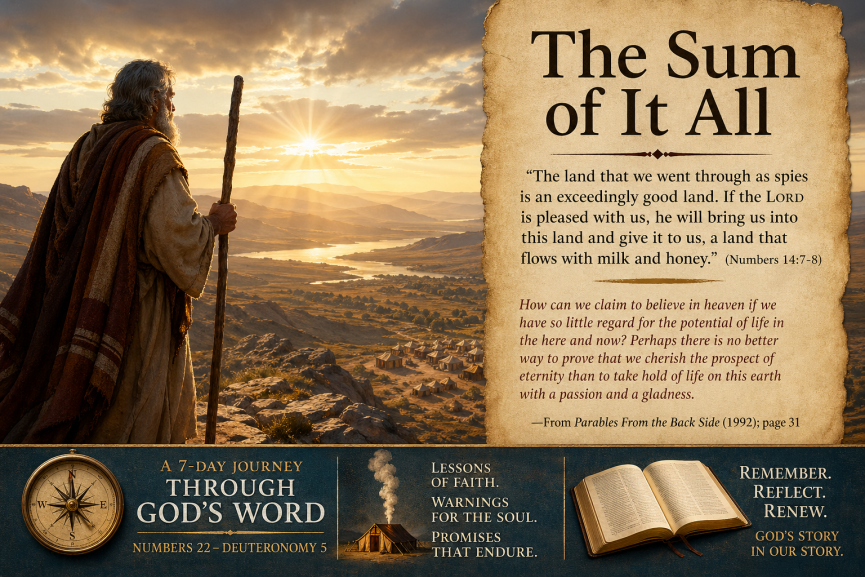
The Sum of It All
“The land that we went through as spies is an exceedingly good land. If the LORD is pleased with us, he will bring us into this land and give it to us, a land that flows with milk and honey” (Numbers 14:7-8).
How can we claim to believe in heaven if we
have so little regard for the potential of life in
the here and now? Perhaps there is no better
way to prove that we cherish the prospect of
eternity than to take hold of life on this earth
with a passion and a gladness.
—From Parables From the Back Side (1992); page 31
Week 9, Day 1
NUMBERS 22–24
The ultimate battlefield of history is the individual human soul. There is the same deployment of forces, the same advancing and retreating, and at last the same satisfaction of victory or shame of defeat.
Rarely do we get a clearer account of such a struggle than we have in this story of Balaam. It is, of course, the story of a conflict between two nations; but as it happens—and as is so often the case in the affairs of state and world—it is settled within the confines of one human soul. What goes on in Balaam’s heart eventually affects a whole people.
Balaam is a talented, gifted human being, able to commune with God in an extraordinary way. At first he answers God rightly, but he tips his hand early in a conversation with Balak’s servants when he says, “Although Balak were to give me his house full of silver and gold, I could not go beyond the command of the LORD my God” (22:18). I don’t think he knew it, but he was announcing his price; Balak now knew he was susceptible to an offer.
So we watch the pendulum of the soul swing, and we smile at times at the way Balak tries to get a curse upon Israel, only to see Balaam offer another blessing. It looks as if this strange man is on the right track, but unfortunately he is too clever for his own good.
PRAYER: Help me, O Lord, to keep my values straight so that I never trade the eternal for the transient; in Jesus’ name. Amen.
We learn later that Balaam betrays God’s plan and leads Israel astray. What signs of such ultimate sin do you see in Balaam?
Week 9, Day 2
NUMBERS 25–27
When we left the battle of the soul yesterday it appeared Balaam had won, for he was blessing Israel, just as God had commanded him to do. Now we learn differently, though we don’t get the details until later. What Balaam could not do through cursing he did through his counsel.
He obeyed the letter of God’s command on his life but violated the spirit.
Balaam sensed that the men of Israel could be led astray by the attractiveness of the Moabite women (25:1; 31:16), and Balak followed his counsel. Balaam, not able to curse Israel, found a way for Israel to curse itself. It was a devastating sin, not only for its sexual infidelity but also because it meant violating what was then so important to Israel, ethnic purity. The New Testament Book of Jude will refer to this sin and will correctly identify Balaam’s error: greed (Jude 11).
But there are bright elements in today’s reading. For one, we learn that in spite of Korah’s sin, his sons do not die; indeed, they must have come to some kind of redemption, because later they author a number of psalms. The daughters of Zelophehad (27:1-11) make a notable early instance of establishing women’s legal rights. And provision is now made for a successor to Moses, the man Joshua. He has been Moses’ right-hand aide for years, and—even more important—he is “a man in whom is the spirit” (27:18).
God’s servants go, but the work of God goes on. There will be life after Moses.
PRAYER: Sometimes, Lord, like Balaam I stay within the letter of the law even as my heart goes outside it. Save me, I pray. Amen.
What factors, both natural and spiritual, did Joshua have going for him as he prepared to succeed Moses?
Week 9, Day 3
NUMBERS 28–31
As we have seen before, life has its holy, memorable occasions. They add luster to life and direction, too, and the biblical writers want to be sure they are not neglected. The Israelites, with a routine lifestyle in a world that seemed never to change, needed such occasions to lift their eyes to the divine; you and I, sometimes almost drowned in an endless sea of sound, activity, and clamor, need these times to lift us from the trivial and the transitory to the eternal.
It isn’t always easy for us to put ourselves in the place of the Israelites in their wilderness wanderings. When we read the rules concerning women and their relationship to husbands and fathers, our modern sensibilities are offended; and when we see the violence of Israel’s vengeance against the Midianites, that offense is heightened. But we need to remember that it is always easy, in another time and place, to say, “They shouldn’t have been like that”; as a matter of fact, future generations will no doubt pass such judgments on us. No generation really has a right to impose its standards or its solutions on the actions of another, because each generation has to cope with its problems with the equipment at hand. We can hardly imagine the struggles of maintaining order in a nomadic wilderness; so we’re probably no more qualified to say what they should have done than they would be to offer advice on dealing with air pollution, nuclear holocaust, and urban crime.
PRAYER: Give me the grace, O God, to be a faithful steward of the times in which I live, demanding as they are; in Christ’s name. Amen.
Why, as you see it, are all these special occasions marked also by special offerings?
Week 9, Day 4
NUMBERS 32–34
If you find the data in these chapters so tedious that you wonder why they are in the Scriptures, you are not the first to have such feelings. Those long-ago persons known as the early church fathers apparently had the same concerns. They concluded that the details of the journey were intended for our instruction, as symbolic of the steps by which Christians leave sin and advance from virtue to virtue, until they come at last to their final abode in God’s eternal home. Does that help you appreciate these chapters more?
Nevertheless, there are also some practical lessons of character to be learned. I admire Moses’ wisdom and firmness in dealing with the tribes who decided to have their inheritance on the other side of the Jordan, and his adaptability, too. As a young man I thought that if I made one wrong decision, the rest of my life would be ruined; I’ve come since to learn that God works patiently with what we give him, even when the pieces do not fit easily into a coherent whole, just as accommodations were made for the tribes that wanted to alter the original plans. God’s laws are strict, but God’s character is gracious.
The warning of 33:55 seems harsh to our ears; but as the history of Israel unfolds, we will see that it was not without foundation. Our problem is still the same. If we become comfortable with an ungodly lifestyle, it will eventually corrupt and destroy us.
PRAYER: It is better, dear Lord, that I learn from the experience of the Israelites than from my own errors. Please? Amen.
The command in Numbers 33:50-56 to “drive out all the inhabitants of the land” seems severe. What justification do you see for such an order?
Week 9, Day 5
NUMBERS 35–36; PSALM 47
The Levites, as I have mentioned before, had no inheritance of land; their inheritance was the Lord. They were given forty-eight cities in which they could live, but as residents rather than owners. Among those cities were the six cities of refuge. In a culture where family vengeance was practiced, these cities provided safety until fair judgment could be had, and afterward if the person was innocent. It was a wonderfully simple and effective plan for its time and place, and it was appropriate that the Levites were the keepers of this security.
Wouldn’t it be wonderful, in our day, if there were some sort of refuge where we could be protected against character assassins until all the facts were in? At one time or another, all of us would have occasion to run to such a refuge, if it existed.
In any event, we Christians ought to fill such a role. Taking the Levites as our pattern, we should protect and sustain those persons whom life is treating badly, whether they be victims of something so vast as political injustice or as ever-present as the “slings and arrows of outrageous fortune.” Every human being has times when he or she wishes there were a place to run and hide, not out of cowardice but out of necessity. Such a refuge is available in prayer, of course; but I’m sure God intends for us to become a physical and active place, in heaven’s stead, for those who are pursued by destruction.
PRAYER: Help me, O God, to provide shelter for those who are victims—by fault or faultless—in the struggle of life; in Christ. Amen.
What logic, other than economics, can you see in regulations that insist on a woman’s marrying within her tribe?
Week 9, Day 6
DEUTERONOMY 1–3; PSALM 48
Some things need to be said twice. The Book of Deuteronomy, which gets its name from two Greek words meaning “second law,” fills that role. It is presented as a kind of valedictory address by Moses, as he bids farewell to the people he has led for forty years and tries to prepare them for the new land they are about to enter.
He begins by reviewing their history. Philosophers say we should study history in order to learn from it. No doubt this is part of Moses’ intention, but there is more than that. For Israel, history was the story of their encounter with God; so to review history was to recall God’s involvement in their lives.
Even so, Moses reminds the people of the sharing of leadership (1:9), and of the crucial decision their ancestors made to turn back at Kadeshbarnea. That decision led to a generation of wandering in the wilderness before at last there could be victories over Sihon and Og—victories that would be celebrated often in song (Psalm 136).
In all of this the people are reminded of the faithfulness of God and also of their own erratic ways. As we read the account, we get a strong feeling that the history of Israel is the history of every person who sets out for God’s promised land. Every spiritual biography has its uneven path between victory and defeat, good judgment and stupidity. And in it all, whether in Israel’s story or ours, God is at work.
PRAYER: Give me the humility and the attentiveness, O God, to learn from the past, so I can make a better future; in Jesus’ name. Amen.
Moses says that because of Israel’s sin, the Lord also became angry with him (Deuteronomy 1:37). Do you think Moses is justified in this statement?
Week 9, Day 7
DEUTERONOMY 4–5; PSALM 49
The laws of God are not arbitrary restraints, but directions to a fulfilled life. So Moses warns Israel that they must give heed to the statutes he is teaching “so that you may live to enter and occupy the land that the LORD, the God of your ancestors, is giving you” (4:1). As an introduction to the laws, Moses reminds the people of the miracles God has done on their behalf. What other great nation, he challenges, has a God so near to be called upon; and what other has a Law as helpful as the one he is about to review (4:7-8)?
But with all that God has done for Israel—bringing them “out of the iron-smelter . . . of Egypt” to be God’s own people (4:20) and making them a nation “by a mighty hand and an outstretched arm” (4:34)—there is nevertheless the danger that their descendants will go astray when they “become complacent in the land” (4:25). Our spiritual memories tend to be very short. Yesterday’s miracle easily becomes today’s non-event.
The commandments in Chapter 5 are in the same order and possess essentially the same content as recorded in Exodus 20. It is interesting that the laws of measurable conduct (murder, adultery, theft, false witness) are stated directly, without commentary, while those that have to do with the more subtle issues of our minds (the sabbath and coveting) are spelled out with specifics.
PRAYER: I want to remember, O Lord, that your laws are for my benefit, and that my best happiness is in loyal obedience; in Christ. Amen.
What difference, if any, do you find between the Ten Commandments as recorded in Exodus 20 and in Deuteronomy 5?
Prayer Time
When do we pray for God to show us new obligations? Perhaps it is time to make such a request to God. Let us pray daily with George Matheson, “Make me a captive, Lord, / and then I shall be free.”
How the Drama Develops NUMBERS 22—DEUTERONOMY 5
We need at times to stop long enough to remember where we have come from, what promises we have made (whether to ourselves, to others, or to God), and to see where we are now. The Book of Deuteronomy fulfills that function for the people of Israel.
Deuteronomy comes to us as a series of addresses by Moses to the nation as they camp in Moab before entering the land toward which they have been headed for a whole generation. It is a farewell address for Moses; he knows he will not be able to accompany the people into their divine inheritance. Now he speaks to the new generation. He recognizes they may not know all that has transpired, or even if they do, they may not recognize the gravity of the decisions made by their parents’ generation.
So he recalls all that happened after the people left Sinai, after the giving of the Law. It’s interesting to see that, whereas Numbers says God instructed Moses to select leaders from each of the twelve tribes to serve as an exploration committee (Numbers 13:1-16), Moses is reported here as saying the people came to him and suggested that men be sent ahead to spy out the land (Deuteronomy 1:22). Perhaps it is that the people made such a request, and that the specific methodology of twelve persons, one from each tribe, came as insight from God.
In any event, the bad news is the committee voted, ten to two, to retreat from their day of opportunity. As a result, the children who at that time did not know right from wrong (1:39) are the ones who will now enter the land.
But the marvel is this: God continued to watch over the recalcitrant people who had, for all practical purposes, rejected their inheritance. Moses recalls victories over King Sihon and King Og and how he urged Joshua to move on without fear. Then Moses becomes an evangelist as he pleads with his people to be obedient to God’s Law. It is this obedience that will cause the other nations to see their wisdom and to acknowledge the wonder of God’s Law (4:6-8). This reminds us that the Israelites were a chosen people—not in the sense of enjoying special favors, though surely they were promised the blessing of God, but particularly in that they were to be a witness to the other nations of humankind.
And because their role is so crucial, God is severely demanding of them. “For the LORD your God is a devouring fire, a jealous God” (4:24). This is the quality of high love—jealous not because of a lack in the one who is jealous but because that one despises anything that might frustrate the fulfillment of the one who is beloved. Tough love indeed!
I think it is this mood that provides the setting, then, for the restating of the Ten Commandments. The commandments are to be a way of life for people in pilgrimage. If they are restrictive, it is only so that life can be made more fulfilling. And as in the presentation in Exodus, these are commandments from the One who has brought the people “out of the land of Egypt, out of the house of slavery” (5:6). It is on this basis that they “shall have no other gods” (5:7) and that the moral structure of their society is ordered.
Seeing Life Through Scripture
I don’t suppose any generation has had a natural love affair with laws and commandments, but I think structures of restraint are especially unattractive to our times. It is not that we are notably worse than other generations; it is just that we have been taught to think more about our rights than about our obligations. Therefore we don’t really hear Moses when he says to his people, “And what other great nation has statutes and ordinances as just as this entire law that I am setting before you today?” (Deuteronomy 4:8).
But it is partly because we have such laws that we can expect, with Moses, that the Lord our God is “so near . . . whenever we call to him” (4:7). Yes, grace makes God accessible even when we break the commandments. But as the saints have learned all through the ages, our communion with God is at its best when we avoid transgression; and the Law is meant to help us do that. Sometimes, in our enthusiasm for the grace of God, we forget how good the Law is. It is the Law, after all, that tells us of life’s pitfalls—of those hazardous areas that can destroy us and frustrate our communion with God. The Law will not save us, but it will help us to keep saved and to enjoy the fullness of the Christian life. If we would give God’s demands a better chance, we would find him nearer; and we would understand why the psalmist said, “How I love your law!” (Psalm 119:97).
Kalas, E. J. (2016). The Grand Sweep: 365 Days From Genesis Through Revelation. Abingdon Press.