
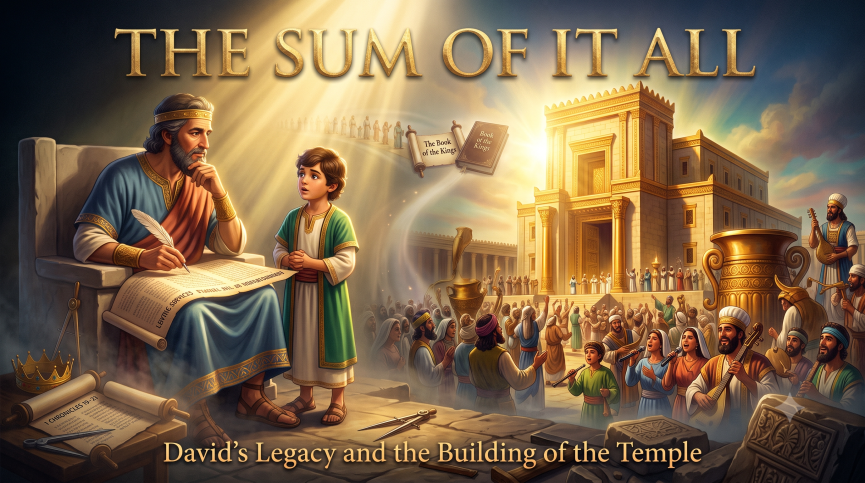
The Sum of It All
“So all Israel was enrolled by genealogies; and these are written in the book of the Kings of Israel” (1 Chronicles 9:1).
Week 20, Day 1
1 CHRONICLES 19–21
The Chronicler begins Chapter 20 exactly as 2 Samuel 11 begins the story of David’s sin with Bathsheba, but he chooses to omit that story. Instead, he tells us of the splendor of David’s crown; perhaps that was a grievous sin, too, though surely not of the proportions of his crime with Bathsheba.
But he is unsparing in the story of David’s numbering of the people of Israel. It seems clear that David’s goal was personal exaltation and that Joab saw through it. Joab, as we have noted before, was not always an exemplary man, but he had the best skill of a military leader in seeing to the heart of an issue. Why number the people, he asked; “Are they not, my lord the king, all of them my lord’s servants?” (21:3). He sensed, too, that the whole nation would suffer for David’s sin, as indeed they did.
David responded in what was the faithful pattern of his life, by acknowledging his sin: “I have done very foolishly” (21:8). His choice of words is appropriate; among other things, sin is inevitably stupid. It sometimes looks clever or expedient on the surface, but in the long run—and sometimes even in the short one—it is stupid. As much as he was able, David tried to pay the penalty for his wrongdoing. When Oman volunteered to give David the site for his sacrifice, David answered, “I will not . . . offer burnt offerings that cost me nothing” (21:24). This, too, is an accepting of life’s penalties, and it is instructive.
PRAYER: When I err, Lord, let me confess it, and pay; in Christ. Amen.
What significance do you see in the Chronicler’s omitting the story of David and Bathsheba?
1 CHRONICLES 22–24
Week 20, Day 2
David isn’t allowed to build the house of the Lord because he has “shed so much blood” in God’s sight (22:8); for although war seems to be taken for granted in the Hebrew Scriptures and seems even to be sanctioned by God, it was clearly not the preferred way to go. Thus Solomon (whose name in Hebrew is a cognate of shalom) will be a man of peace.
But David isn’t going to leave his beloved project without his mark on it. With the older generation’s natural skepticism about the judgment and ability of the young (“My son Solomon is young and inexperienced . . . ; I will therefore make preparation” [22:5]), David makes extensive preparation, not only in providing materials but also in setting up administrative structures for the temple (23:2-23). Now that the Levites no longer need to carry the tabernacle and its equipment, they must be organized for the care of the new temple. David was obviously an able administrator, and he wanted to be sure that this matter which was nearest to his heart was done perfectly. And like many administrators, especially older ones, he felt he was the best equipped to do that.
But in all these details, one senses David’s great love for God and for God’s dwelling place. His passion was more than the manner of a perfectionist; he had an awe of the glory of God, as he had experienced it over the rough and ready years of his life, and he wanted this new house of God to be worthy of such exceeding glory.
PRAYER: I see many houses of worship, so none is unique as was David’s; nevertheless, give me the same sense of awe; in your name. Amen.
The Chronicler gives us more information about David’s influence on Solomon in planning the temple; again, what is the significance in this?
1 CHRONICLES 25–27; PSALM 82
Week 20, Day 3
I once watched a woman doing needlepoint. It seemed so painstaking, so tedious; every stitch was precise. But she was reveling in it, because it was a wedding gift for her son and daughter-in-law. I have something of that feeling about David as I read the list of musicians and gatekeepers for the temple. It is a detailed listing of the people who were to make worship effective in the new house, and what might seem tedious detail to us must have seemed beautiful to him—“something beautiful for God.”
One of the musicians is Heman, who had been blessed with fourteen sons and three daughters, all of them “under the direction of their father for the music in the house of the LORD” (25:5-6). It’s interesting to come upon this reference to him, since he is identified as author of one of the psalms.
As a young pastor, I often became frustrated with the burden of administration, until one day I realized that administration and minister are almost identical words—and that, properly done and rightly dedicated to God, administration is a ministry. David and the Chronicler could have told me as much long before. It is clear that they saw the list of officers, military leaders, and tribal leaders as people who were fulfilling a calling before the Lord. They were to be “men of ability . . . for everything pertaining to God and for . . . the king” (26:32).
PRAYER: Dear Lord, help me do routine tasks with a sense of glory until all I do is made beautiful for you; in Jesus’ name. Amen.
Several persons in 1 Chronicles 26 and 27 are singled out for a descriptive line regarding their character or worth. Identify these persons and their qualifications.
1 CHRONICLES 28–29; PSALM 83
Week 20, Day 4
As David passes the kingdom to his son, his major theme is the building of the temple. A critic might suggest that this is simply the emphasis of the Chronicler, but David’s enthusiasm for this project is consistent with his lifelong pattern. He was a person after God’s own heart because he pursued God all of his days. Probably nothing was dearer to him than the building of the temple, and not being able to do so was no doubt the biggest disappointment of his life.
His vision for the temple is that it “will not be for mortals but for the LORD God” (29:1). Here is an issue for every church architect and every building committee. Obviously a church must be built in such a way as to meet human needs in the worship of God, but David was moved by the high conviction that it must always be seen as a house to the glory of God.
And the people caught his spirit, so that “with single mind they . . . offered freely to the LORD” (29:9). In receiving the gifts David acknowledged that everything they had given “comes from your hand and is all your own” (29:16). It was a day to remember as the people “ate and drank before the LORD . . . with great joy” (29:22).
The Chronicler lets us leave David on this high note, without giving us the story of Adonijah’s rebellion (1 Kings 1) and the struggles of succession. Like every historian, he chooses what to use and what to omit.
PRAYER: Renew my sense of awe at the glory of your house. Amen.
Since this material was written for the people who had returned to Jerusalem from exile, what would be the significance of these statements from and about David?
2 CHRONICLES 1–3
Week 20, Day 5
Solomon knew what his position required, and he sought it. He was wise enough to realize that he was not capable of ruling “this great people of yours” (1:10), so he asked for the required wisdom. In these days when we are often told that our massive cities are ungovernable and that no person is really capable of bringing together all the reins of administration for complex modern government, one wishes that candidates for office might catch Solomon’s spirit.
When Solomon’s wish is granted, he is told that he will also receive “possessions, wealth, honor” (1:11); and something in us says, “Of course!” Because if Solomon is equipped to do his work really well, all these other gifts—and many more—will come as by-products of his success. In seeking the best for his people, Solomon unconsciously was getting the best for himself. And there’s a parable in that, of course.
Someone has said that among earthly gifts, no person is more fortunate than the one who discovers the work he or she loves most to do, then finds that he or she possesses the gifts to do it really well. Unfortunately, some do not recognize their good fortune even when they have it in hand. As Shakespeare said:
“Desiring this man’s art, and that man’s scope,
With what I most enjoy contented least” (Sonnet xxix).
Much to Solomon’s credit, he knew what he needed—and God gave it.
PRAYER: Help me, O Lord, to find my place before you; then grant me, please, the heart and skills to do my work truly well; in Jesus’ name. Amen.
Reread Solomon’s letter to King Hiram (Huram, 2 Chronicles 2:3-10). What impressions does it give you about Solomon as a person and about his feelings for the temple of God?
2 CHRONICLES 4–7
Week 20, Day 6
If you’re like me, you may be uneasy with all the wealth that is built into the temple (4:7-22); gold seems a common commodity! Some qualifying words should be spoken. Remember that this was the only house of worship in the nation; all the investment of worship was in this place. Remember, too, that Israel’s society and their faith made full provision for the poor.
And, of course, grandeur was of the essence of the temple, because it was meant to reflect the glory of God; simplicity had its place elsewhere, but here the aim was magnificence. I’m afraid we can easily use the ornateness of the temple to distract us from our contemporary sins. Our generation pours its wealth into massive government buildings, spectacular shopping malls, and cathedral-like entertainment centers, all of which we pretty much take for granted.
We discussed Solomon’s wonderful prayer earlier, but let’s pause now to see the foundation on which the prayer and the divine-human relationship are based. As Solomon completes the prayer and the glory of God is revealed, the priests bow to the ground and give thanks, extolling God’s goodness and saying, “for his steadfast love endures forever” (7:3). That phrase is a recurring motif of Old Testament worship. It is the Hebrew hesed, which is a precursor of grace. To understand it is to realize God’s enduring love for Israel.
PRAYER: Thank you, Lord, for your steadfast love toward me. Amen.
As you read the description of the dedication of the temple, compare it with the most recent service of worship you have attended.
2 CHRONICLES 8–9; PSALM 84
Week 20, Day 7
The human mind has wondrous powers, one of the most troublesome of which is its ability to rationalize. For political reasons, Solomon marries Pharaoh’s daughter, just as he married into several other royal families, thus cementing his relationships with a number of countries. But he feels there would be something inappropriate about having the daughter of a pagan king in the house of his father David, because there was a special holiness to that house, since the ark of the Lord had been there (8:11). What a careful line Solomon drew, being uncomfortable with his wife’s inhabiting a house where the ark of God had been but being untroubled with her inhabiting his own life! What tangled webs of inconsistencies we are!
The Chronicler is less critical of Solomon than is the writer of Kings. He tells us of his meeting with the Queen of Sheba and of his great wealth; he was so blessed that he “excelled all the kings of the earth in riches and in wisdom” (9:22). We read that he had four thousand stalls for his horses and twelve thousand horses; and we recall that Deuteronomy had warned that Israel’s king should never “acquire many horses for himself,” nor should he “acquire many wives for himself’ (Deuteronomy 17:16-17). And then one is troubled that with all that is said about Solomon’s achievements and his wealth, we read almost nothing, after the temple dedication, of his communion with God. And that’s where the biography grows sad.
PRAYER: Help me, O Lord, as I live in a world of human success and material possessions, to keep my soul focused on you; in Christ. Amen.
What was it about Solomon’s wisdom that impressed the Queen of Sheba so much? Do you think that perhaps wisdom was more highly prized in those days than it is today?
Prayer Time
Here are some of my personal preconceptions about people, movements, and policies about which I ought to pray:
How the Drama Develops 1 CHRONICLES 19—2 CHRONICLES 9
It becomes clear, as one reads First and Second Chronicles, that this writer tends to idealize both David and Solomon—and to a lesser degree, also such kings as Asa, Hezekiah, and Josiah. Am I suggesting his writing is untrue? Not at all. Am I raising questions about his divine inspiration? Again, not at all. I believe wholeheartedly in the inspiration of the Scriptures, but I am sure God worked through persons who had particular convictions and prejudices—and also, that God used those prejudices for good purposes.
Anyone who writes history writes selectively. Always there is more data than can be used, so the writer must choose what to use and what to omit. The Chronicler omits, to use an obvious example, the story of David’s infidelity with Bathsheba. Perhaps he didn’t want to remind his readers of this painfully human side of David. Or perhaps, on the other hand, he simply felt it was not data that really mattered in one’s estimate of David’s kingship. Personally, I consider the story important because for me, the measure of David’s loyalty to God was reflected not only in his public decisions but also in his private life, and also because I think that the story reveals David’s readiness to accept prophetic rebuke. But the Chronicler may have judged the whole event not germane to the portrait of David for the particular audience he expected to reach.
In the same way, the Chronicler does not mention David’s family troubles with Amnon and with Absalom, his flight from Jerusalem and the humiliations he suffered during that period, or his problems with his wife Michal. Solomon too is treated carefully. There is nothing about the attempted coup by his half-brother Adonijah, nor is there reference to Solomon’s carrying out executions ordered by his father. And we are spared the story of his following after the gods of his foreign wives. The Chronicler is preaching to a different audience than the writer of Kings, and he selects his material accordingly.
On the other hand, the Chronicler includes much not found in Samuel and Kings. For instance, he often carries the story by recording various speeches—in total, some 165 speeches of various lengths, only 95 of which are found in the parallel texts. And the genealogies! We have several chapters of such material, no doubt reflecting the renewed importance of these family lines as the people begin to rebuild their homeland and to reestablish themselves as a nation.
I think it especially significant that the Chronicler tells us of the movement of some remnants of the ten northern tribes back to Judah and Jerusalem. He wants us to know that although the northern tribes became apostate and ceased to exist as a people after they were taken captive by the Assyrians, nevertheless, the Southern Kingdom still represented all of the people. Starting only as Judah and Benjamin, they soon were joined by Levi (2 Chronicles 11:14), which assured proper patterns of worship in the temple, and later by—specifically—members of the tribes of Ephraim, Manasseh, and Simeon (15:9), then in smaller measure by persons from other tribes. This must have been very important as visible evidence Israel was still a complete nation.
Seeing Life Through Scripture
As we have noted elsewhere, it is sometimes said that Israel’s prophets wrote like historians and its historians wrote like prophets. That is to say, both believed that nations live out their story under God. The biblical writers never saw Israel’s history as simply a series of events; they were events that could be understood only if seen through the lens of God’s purpose and involvement.
So, of course, historians like the Chronicler wrote with prejudice. When they viewed the reign of a king, they wanted to know if he had fulfilled God’s purposes. Had he led the people in godly ways, or had he built or encouraged “high places,” those alternative worship settings? In the same fashion, the Chronicler chose to emphasize some things about Judah’s kings, play down others, and completely ignore still others.
This shouldn’t surprise us, nor should it cause us to read Chronicles with a skeptical eye. History is always written this way, sometimes intentionally, and sometimes unknowingly even if obviously. That’s why we have a whole school of contemporary historians who are known as revisionists. They choose to dismantle what historians wrote decades or so ago, because they’re sure they have less prejudiced data. In truth, they generally have data that is simply built on different prejudices. We should by all means seek truth in history; but we should recognize we always do so with our own preconceptions. And, yes, prejudices.
Kalas, E. J. (2016). The Grand Sweep: 365 Days From Genesis Through Revelation. Abingdon Press.